


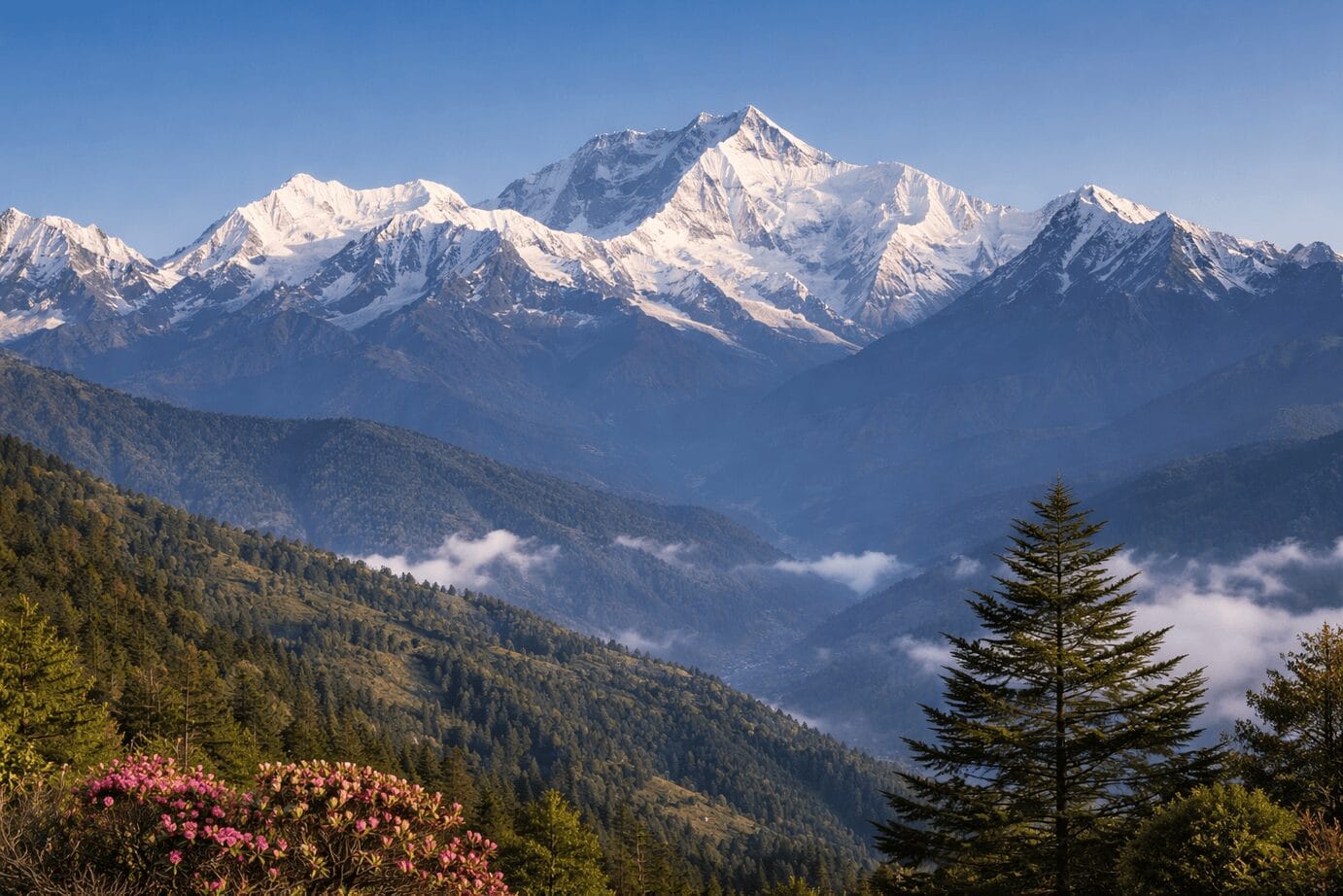
Standing tall at 8,586 meters above sea level, Mount Kanchenjunga peak commands respect as the third highest mountain on Earth. Straddling the border between Nepal and the Indian state of Sikkim, this magnificent giant has captivated mountaineers, pilgrims, and nature enthusiasts for generations. Its name, derived from Tibetan words meaning “The Five Treasures of Snows,” refers to its five distinct peaks that hold both geographical significance and deep spiritual meaning for the communities living in its shadow.
Unlike its more famous neighbors, Mount Everest and K2, Mount Kanchenjunga peak maintains an aura of mystery and reverence that sets it apart. The mountain’s remote location, challenging weather conditions, and sacred status among local populations have helped preserve its pristine environment while limiting the number of climbers who attempt to conquer its formidable slopes each year.
The Geography and Location of Kanchenjunga
Mount Kanchenjunga peak rises from the eastern section of the Himalayas, creating a natural boundary between Nepal’s Taplejung District and India’s Sikkim state. The massif consists of five main peaks, with the highest reaching 8,586 meters, making it just 262 meters shorter than K2 and 863 meters lower than Mount Everest.
The mountain’s position creates a unique geographical phenomenon. While the main summit lies in Nepal, three of the five peaks fall within Sikkim’s borders, making Kanchenjunga the highest mountain in India. This shared ownership has fostered cooperation between the two nations in conservation efforts and mountaineering regulations.
The Kanchenjunga massif covers approximately 2,035 square kilometers and feeds several major river systems. The Tamur River flows from its eastern slopes, while the Teesta River originates from its glaciers on the Sikkim side. These water sources sustain millions of people downstream and support diverse ecosystems throughout the region.
The Five Sacred Peaks
The name Kanchenjunga translates to “The Five Treasures of Snows,” with each peak representing a different treasure according to local Buddhist traditions. These treasures symbolize gold, silver, gems, grain, and holy books. The five summits of Mount Kanchenjunga peak include the main summit at 8,586 meters, Kanchenjunga West at 8,505 meters, Kanchenjunga Central at 8,482 meters, Kanchenjunga South at 8,494 meters, and Kangbachen at 7,903 meters.
Local communities consider the mountain a deity and protector of the region. The Lepcha people, indigenous to Sikkim, worship Kanchenjunga as their guardian mountain and believe it houses their ancestors’ spirits. This sacred status has influenced mountaineering ethics, with climbers traditionally stopping a few meters short of the actual summit out of respect for local beliefs.
The spiritual significance extends beyond local communities. Buddhist monasteries dot the landscape surrounding the mountain, with monks performing rituals and ceremonies to honor the peaks. The Tibetan Buddhist tradition views mountains as dwelling places for protective deities, and Kanchenjunga holds particular importance in this cosmology.
Climate and Weather Patterns
The weather around Mount Kanchenjunga peak presents extreme challenges for climbers and researchers. The mountain experiences some of the most severe weather conditions in the Himalayas, with temperatures dropping below minus 40 degrees Celsius during winter months. The region receives heavy snowfall from the monsoon system between June and September, making climbing virtually impossible during this period.
Spring and autumn provide the best weather windows for expeditions. May offers pre-monsoon conditions with relatively stable weather, while September and October bring post-monsoon clarity and moderate temperatures. However, the mountain’s eastern location exposes it to weather systems from the Bay of Bengal, creating unpredictable conditions that can change within hours.
The jet stream, a powerful band of winds in the upper atmosphere, significantly impacts climbing conditions on higher elevations. During winter, the jet stream descends to lower altitudes, creating winds exceeding 200 kilometers per hour near the summit. Even during favorable seasons, climbers must contend with sudden storms, avalanches, and extreme temperature fluctuations.
Mountaineering History and Notable Expeditions
The conquest of Mount Kanchenjunga peak has a fascinating history filled with triumph and tragedy. Early expeditions in the 1900s faced numerous setbacks due to limited equipment, inadequate maps, and underestimation of the mountain’s technical difficulties. The first serious attempt came in 1905 when Aleister Crowley led an expedition that ended in disaster, claiming several lives.
British mountaineers made multiple attempts throughout the 1920s and 1930s, but the mountain resisted all efforts. The breakthrough came on May 25, 1955, when Joe Brown and George Band, members of a British expedition led by Charles Evans, successfully reached the summit. True to their promise to local communities, they stopped a few feet below the actual summit, establishing a tradition that continues today.
The first ascent opened doors for future expeditions, though Mount Kanchenjunga peak remains one of the deadliest mountains in the world. The mountain has a fatality rate of approximately 14 percent, higher than Mount Everest’s eight percent. Notable achievements include the first winter ascent in 1986 by Polish climbers Jerzy Kukuczka and Krzysztof Wielicki, and the first successful solo climb in 1983 by Pierre Beghin.
Indian mountaineer Phu Dorjee Sherpa became the first Indian to summit Kanchenjunga in 1978, while Santosh Yadav made history as the first woman to climb the peak from the Indian side in 1992. These achievements inspired generations of South Asian mountaineers and demonstrated that Himalayan giants could be conquered with determination and proper preparation.
Technical Challenges and Climbing Routes
Attempting to summit Mount Kanchenjunga peak requires exceptional mountaineering skills and experience with high-altitude climbing. The mountain offers several routes, with the Southwest Face from Nepal being the most popular. This route follows a path through the Yalung Glacier, ascending through several camps before reaching the summit ridge.
The climbing presents technical challenges that demand expertise in ice climbing, rock climbing, and high-altitude mountaineering. Climbers must navigate through crevasse fields, ice walls, and exposed ridges where a single mistake could prove fatal. The final push to the summit involves traversing knife-edge ridges with sheer drops of thousands of meters on either side.
Avalanche danger remains constant throughout the climbing season. The heavy snowfall and steep slopes create conditions where massive snow slides can occur without warning. Several expeditions have lost team members to avalanches, particularly in the lower camps where accumulating snow becomes unstable.
Altitude sickness poses another significant threat. The summit of Mount Kanchenjunga peak lies well within the “death zone,” where oxygen levels drop to approximately one-third of sea level concentrations. Climbers must acclimatize properly, spending weeks at intermediate camps to allow their bodies to adjust before attempting the summit push.
Flora and Fauna of the Kanchenjunga Region
The areas surrounding Mount Kanchenjunga peak support remarkable biodiversity, with ecosystems ranging from subtropical forests at lower elevations to alpine meadows and permanent snow fields. The Kanchenjunga Conservation Area in Nepal and the Khangchendzonga National Park in Sikkim protect these habitats and the species within them.
Lower elevation forests contain rhododendrons, magnolias, oak, and bamboo species. During spring, the hillsides explode with color as rhododendron forests bloom in shades of red, pink, and white. These forests provide habitat for red pandas, Himalayan black bears, and various deer species.
As elevation increases, the vegetation transitions to alpine scrubland and meadows. These areas host unique plant species adapted to harsh conditions, including several medicinal herbs valued in traditional Ayurvedic and Tibetan medicine. The region’s flora includes rare orchids, primulas, and gentians that attract botanists from around the world.
Wildlife in the Kanchenjunga region includes snow leopards, which hunt blue sheep and Himalayan tahrs on rocky slopes. The elusive cats rarely appear to humans, but camera traps and tracking studies confirm healthy populations in protected areas. Other notable species include musk deer, Himalayan marmots, and the blood pheasant, Sikkim’s state bird.
Bird enthusiasts visit the region to spot species like the Himalayan monal, satyr tragopan, and various species of eagles and vultures. The diverse elevation gradient creates multiple ecological zones, allowing numerous species to coexist within relatively small geographical areas.
Cultural Significance and Local Communities
Communities living in the shadow of Mount Kanchenjunga peak have developed rich cultural traditions deeply connected to the mountain. The Sherpa, Limbu, Rai, and Lepcha peoples maintain spiritual practices that honor Kanchenjunga as a living deity rather than merely a geographical feature.
Traditional festivals and ceremonies incorporate the mountain into their rituals. In Sikkim, the Pang Lhabsol festival celebrates Kanchenjunga as the guardian deity, with masked dances and offerings made to ensure the mountain’s continued protection of the region. Similar ceremonies occur on the Nepali side, where communities perform pujas before and after climbing seasons.
The mountain influences daily life in practical ways as well. Weather patterns originating from Kanchenjunga determine agricultural cycles, with farmers timing their planting and harvesting based on traditional knowledge passed down through generations. The glaciers and snowmelt provide water for irrigation, drinking, and hydroelectric power generation.
Tourism and mountaineering have brought economic opportunities but also challenges to traditional ways of life. Many young people from mountain communities work as guides, porters, and support staff for expeditions, earning income that supports their families. However, this shift has sometimes led to cultural changes as traditional practices compete with modern economic pressures.
Trekking Routes and Tourism
While climbing Mount Kanchenjunga peak requires extensive mountaineering experience, trekking routes around its base attract thousands of visitors annually. The Kanchenjunga Base Camp trek in Nepal offers spectacular views without requiring technical climbing skills, though the journey demands good physical fitness and proper acclimatization.
The trek typically takes 20 to 25 days, starting from the town of Taplejung in eastern Nepal. Trekkers pass through remote villages, cross high mountain passes, and witness diverse landscapes from subtropical forests to alpine meadows. The route provides opportunities to experience local culture, visiting traditional villages where life has changed little over centuries.
Two base camps serve different perspectives of the mountain. The South Base Camp, also called Yalung Base Camp, offers views of the southern face, while the North Base Camp at Pangpema provides stunning vistas of the north face. Many trekkers complete a circuit visiting both base camps, though this requires additional time and stamina.
On the Sikkim side, trekking options remain more restricted due to the area’s sensitive border location with China and Bhutan. Permits require careful planning, and trekkers must join organized groups rather than trekking independently. The Goechala Trek represents the most popular route in Sikkim, offering views of Mount Kanchenjunga peak from various viewpoints.
Infrastructure along trekking routes includes teahouses and basic lodges in lower villages, though facilities become increasingly sparse at higher elevations. Trekkers must prepare for basic accommodations and carry essential supplies, particularly during shoulder seasons when some facilities close.
Conservation Efforts and Environmental Challenges
Protecting the fragile ecosystems around Mount Kanchenjunga peak has become increasingly important as tourism and climate change impact the region. The Kanchenjunga Conservation Area Project, established in 1997, covers 2,035 square kilometers in Nepal and works to balance conservation with sustainable development for local communities.
Climate change poses significant threats to the mountain environment. Glaciers are retreating at accelerating rates, with studies documenting substantial ice loss over recent decades. This melting affects water availability for downstream communities and increases risks of glacial lake outburst floods, which could devastate villages in valleys below.
Waste management presents ongoing challenges, particularly along climbing routes and trekking paths. While Mount Kanchenjunga peak sees fewer climbers than Everest, waste accumulation still occurs. Conservation organizations and expedition companies have implemented programs requiring climbers to carry out all waste, and cleanup expeditions periodically remove accumulated debris.
The establishment of the Khangchendzonga Biosphere Reserve in Sikkim and the Kanchenjunga Conservation Area in Nepal provides legal protection for wildlife and habitats. These protected areas work to prevent poaching, illegal logging, and unsustainable resource extraction while supporting community development initiatives that provide alternatives to environmentally damaging practices.
Comparing Kanchenjunga to Other Eight-Thousanders
As one of only fourteen mountains exceeding 8,000 meters in elevation, Mount Kanchenjunga peak belongs to an exclusive club of the world’s highest summits. While it ranks third in height, it presents unique challenges that distinguish it from its taller neighbors, Everest and K2.
The mountain’s remoteness creates logistical challenges absent on more accessible peaks. Reaching base camp requires days of trekking through remote terrain with limited infrastructure. This isolation means rescue operations become extremely difficult, with helicopter evacuation often impossible at higher elevations due to thin air and unpredictable weather.
Technical difficulty on Kanchenjunga matches or exceeds that of other eight-thousanders. The climbing combines steep ice faces, exposed ridges, and sections requiring advanced mountaineering skills. Unlike Everest, where fixed ropes and commercial expeditions have created a relatively standardized climbing experience, Kanchenjunga maintains a more traditional mountaineering character with fewer support structures.
The mountain’s fatality rate reflects these challenges. While exact statistics vary, Mount Kanchenjunga peak consistently ranks among the deadliest eight-thousanders. The combination of objective hazards like avalanches and extreme weather, technical climbing difficulties, and limited rescue infrastructure contributes to this sobering statistic.
Future of Kanchenjunga Tourism and Mountaineering
The future of Mount Kanchenjunga peak as a destination for climbers and trekkers depends on balancing increased interest with environmental protection and respect for local cultures. Current trends suggest growing tourism, with more people seeking alternatives to overcrowded routes on Everest and other popular peaks.
Sustainable tourism development initiatives aim to ensure that growth benefits local communities while minimizing environmental impact. Programs training local guides, developing eco-friendly lodges, and creating community-based tourism enterprises help distribute economic benefits more equitably while maintaining cultural authenticity.
Technological advances are changing the mountaineering experience on Kanchenjunga. Improved weather forecasting, satellite communications, and better equipment increase success rates and safety margins. However, these technologies also raise questions about maintaining the adventure and self-reliance that traditionally characterized Himalayan mountaineering.
Climate change will continue reshaping the mountain environment. As glaciers retreat and weather patterns shift, traditional climbing routes may become more dangerous or even impassable. New routes might emerge, but increased rockfall, unstable ice, and unpredictable weather patterns will present fresh challenges.
Conclusion
Mount Kanchenjunga peak stands as a testament to nature’s grandeur and the enduring human spirit of exploration. Its towering presence dominates the landscape of eastern Nepal and Sikkim, serving simultaneously as a geographical landmark, spiritual symbol, and ultimate mountaineering challenge. The mountain’s five sacred peaks continue to inspire reverence among local communities while attracting adventurers from around the globe.
The story of Kanchenjunga encompasses triumph and tragedy, ancient traditions and modern challenges, pristine wilderness and growing human impact. As the third highest mountain on Earth, it maintains a character distinct from its more famous neighbors, offering experiences that blend extreme mountaineering with cultural immersion and environmental awareness.
Whether viewed from a remote village, a trekking trail, or the thin air near its summit, Mount Kanchenjunga peak commands respect and wonder. Its future depends on collective efforts to preserve its environment, honor local traditions, and ensure that this magnificent mountain continues to inspire future generations while remaining a sacred space where earth reaches toward sky.
More from The Daily Mesh:
- 7 Things You Should Stop Doing By 30 (And What To Do Instead)
- Is Homework Outdated? New Research Challenges Traditional Learning
- The Cultural Impact of the Taylor Swift Eras Tour