


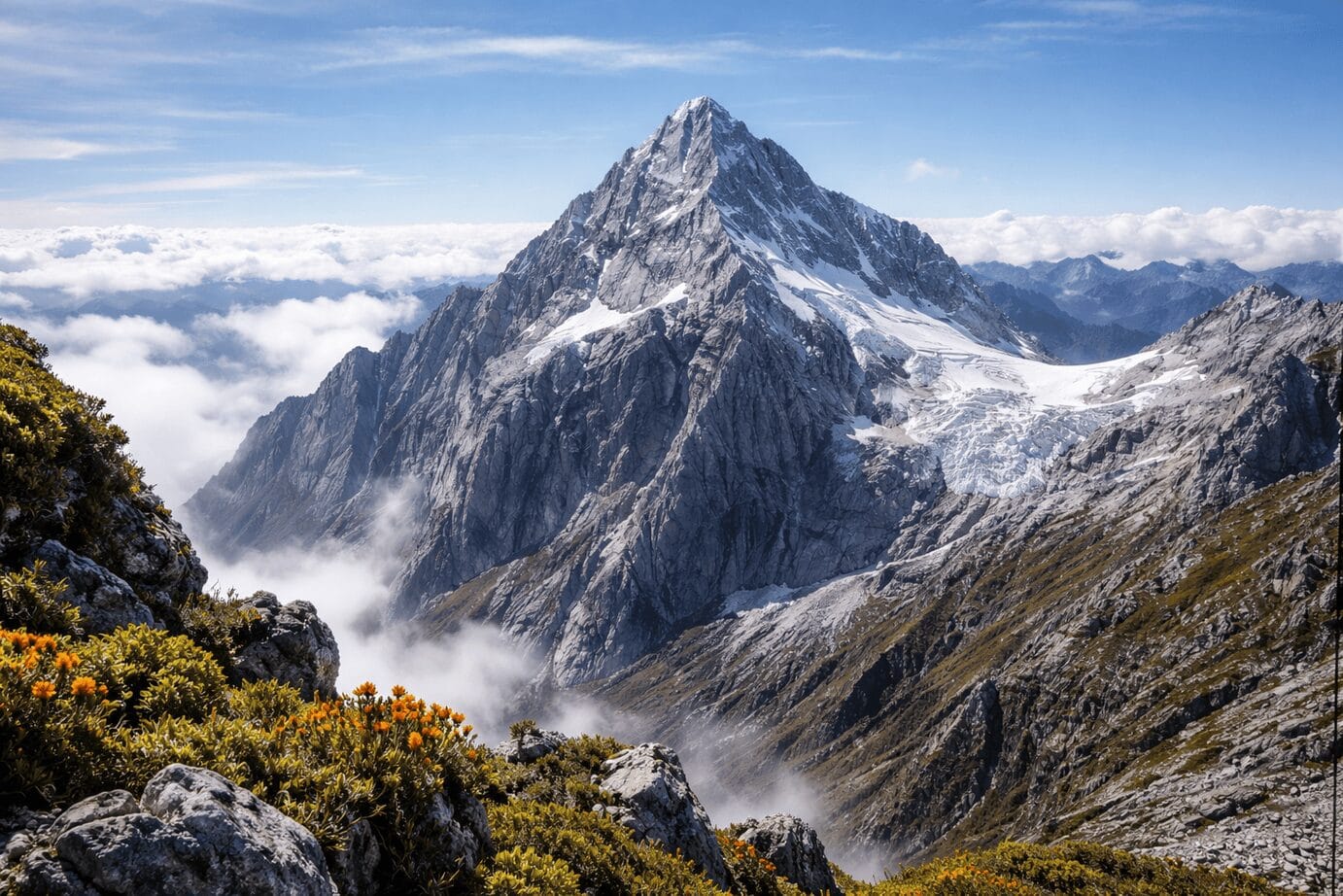
The island of New Guinea harbors one of the world’s most extraordinary mountaineering destinations, a place where tropical rainforests give way to glacial ice, and where indigenous cultures have thrived for millennia beneath peaks that pierce the equatorial sky. Puncak Jaya Indonesia, also known internationally as Carstensz Pyramid, rises 4,884 meters above sea level in the remote Papua province, claiming its title as the highest mountain in Indonesia and the tallest island peak on Earth.
This limestone giant stands apart from other famous mountains not only because of its geographical isolation but also due to the unique combination of technical climbing challenges, political complexities, and cultural sensitivities that surround it. For mountaineers pursuing the Seven Summits challenge, Puncak Jaya Indonesia represents perhaps the most logistically difficult objective, requiring extensive planning, significant financial resources, and a respect for the indigenous communities who consider these mountains sacred.
The Geographic Marvel of Puncak Jaya Indonesia
Located in the Sudirman Range within Papua’s central highlands, Puncak Jaya Indonesia sits approximately 50 kilometers from the Arafura Sea. The mountain’s existence challenges common perceptions about tropical geography—here, just four degrees south of the equator, glaciers persist despite global warming’s relentless advance. These ice fields, among the few remaining equatorial glaciers on the planet, have become critical indicators of climate change, shrinking dramatically over the past century.
The surrounding landscape presents a study in dramatic contrasts. Dense montane forests blanket the lower elevations, home to tree kangaroos, birds of paradise, and countless endemic species found nowhere else on Earth. As altitude increases, the vegetation transitions through cloud forests and alpine meadows before reaching the barren rock and ice of the summit zone. This ecological gradient compressed into a few thousand meters of elevation creates one of the most biodiverse mountain environments imaginable.
The mountain itself consists primarily of limestone, a relatively rare composition for such a tall peak. This geological quirk results from the collision of tectonic plates that continues to push New Guinea’s mountains skyward. The limestone’s susceptibility to erosion has created the dramatic vertical faces and sharp ridges that give Carstensz Pyramid its distinctive profile and its reputation as a technical climbing challenge.
The History Behind the Name
Dutch explorer Jan Carstensz first reported seeing snow-covered mountains near the equator in 1623, though his accounts were met with widespread skepticism in Europe. How could snow exist in the tropics? It wasn’t until 1899 that another European expedition confirmed Carstensz’s observations, finally validating what indigenous Papuans had always known—that their homeland harbored mountains tall enough to hold permanent ice.
The Indonesian name Puncak Jaya, meaning “Victory Peak,” was officially adopted after Indonesia gained control of Western New Guinea in 1963. The mountain is also called Nemangkawi in the local Amungme language, and these indigenous names carry deep cultural significance. For the Amungme people, the mountain represents the head of their ancestral mother, with the surrounding peaks forming her body as she lies in eternal rest. This spiritual connection to the landscape adds layers of meaning to any attempt to climb Puncak Jaya Indonesia.
The peak’s inclusion in the Seven Summits challenge remains contentious. Some mountaineers argue that Mount Kosciuszko in Australia should represent Oceania, as it sits on the continental mainland. However, if one considers Oceania in its broader geographical sense—encompassing the islands of the Pacific—then Puncak Jaya Indonesia clearly claims the title as the highest point. This debate adds an asterisk to the accomplishments of Seven Summits climbers, with purists often attempting both peaks to avoid controversy.
Technical Climbing Routes and Challenges
Unlike the mountaineering giants of the Himalayas or Andes, the Carstensz Pyramid climb doesn’t require high-altitude acclimatization—at least not in the traditional sense. At 4,884 meters, altitude sickness remains a concern, but the greater challenges lie in the mountain’s technical rock climbing requirements and the grueling approach through Papua’s remote wilderness.
The normal route up Puncak Jaya Indonesia involves steep limestone faces, exposed ridges, and sections requiring solid rock climbing skills at grades up to 5.7 or 5.8 on the Yosemite Decimal System. Climbers must be comfortable with significant exposure, meaning steep drops on either side of narrow ridges with minimal margin for error. Fixed ropes assist on the most difficult sections, but wet limestone can become treacherously slippery, particularly during the frequent storms that sweep across the mountain.
Most Papua mountain expeditions begin with a flight to Timika, a mining town on Papua’s southern coast. From there, climbers historically trekked for five to seven days through thick jungle and across rivers to reach base camp. This approach, while physically demanding, offered climbers a gradual introduction to the environment and invaluable cultural exchanges with local guides and porters. However, in recent years, helicopter access has become more common, dramatically reducing approach time but also removing much of the adventure and cultural immersion that made the journey special.
The climb itself typically takes two to three days from base camp, weather permitting. Base camp sits at approximately 4,200 meters, offering stunning views of the surrounding peaks and the Carstensz Glacier, though this ice field has shrunk to a fraction of its former size. From base camp, climbers navigate loose scree slopes before reaching the technical rock sections that characterize the summit push.
The descent, often overlooked in planning, proves equally challenging. Tired climbers must downclimb or rappel the same technical sections they ascended, requiring sustained focus and energy reserves. The limestone’s sharp edges can damage ropes, making careful rope management essential for safety.
Climate and Best Climbing Seasons
The equatorial location of Puncak Jaya Indonesia means that traditional seasonal patterns don’t apply as they do on mountains at higher latitudes. Instead, climbers must navigate Papua’s complex weather patterns, which feature high precipitation year-round. The Indonesian highest peak receives substantial rainfall, with some estimates suggesting certain slopes receive over 5,000 millimeters annually—making it one of the wettest mountainous regions on Earth.
That said, relative dry seasons occur between March and May, and again from September to November. During these windows, climbers find marginally better weather conditions, with fewer intense storms and slightly more stable climbing conditions. However, “dry season” remains a relative term in Papua’s mountains, and climbers should expect rain, fog, and potentially snow regardless of timing.
Temperature variations prove less dramatic than on higher peaks. Summit temperatures typically range from just above freezing to around 10 degrees Celsius during daylight hours, dropping below freezing at night. The real challenge comes from the persistent moisture, which can soak gear and make maintaining warmth difficult despite moderate temperatures.
Weather windows on the mountain tend to be brief. Clouds typically engulf the peaks by midday, bringing precipitation and obscuring visibility. This pattern means summit pushes typically begin in the pre-dawn darkness, aiming to reach the top and begin descending before conditions deteriorate. The rapidly changing weather can trap unprepared parties, turning a challenging climb into a dangerous survival situation.
Cultural Significance and Indigenous Perspectives
Any discussion of Puncak Jaya Indonesia must acknowledge the indigenous communities who have lived in these mountains’ shadow for thousands of years. The Amungme, Dani, and Moni peoples have deep spiritual and cultural connections to these peaks, viewing them not merely as geographical features but as sacred ancestors and the source of their identity.
For the Amungme people in particular, the mountain represents their ancestral mother, and the entire landscape embodies their creation stories and spiritual beliefs. The extraction of natural resources from these lands—particularly through the massive Grasberg mine, one of the world’s largest gold and copper mines—has created profound conflicts between indigenous rights, corporate interests, and governmental authority.
Climbers planning a Papua mountain expedition must recognize that they’re entering a politically sensitive region where indigenous peoples continue to struggle for recognition of their rights and sovereignty. The Indonesian government’s policies in Papua remain controversial, with ongoing tensions between independence movements and Jakarta’s authority. These complexities affect climbing permits, access routes, and the ethical considerations every climber should weigh before attempting the mountain.
Responsible climbers engage local guides and porters, ensuring fair wages and respectful interactions. These guides bring invaluable local knowledge, from weather patterns to route conditions, while providing crucial economic opportunities for communities with limited alternatives. The cultural exchange between climbers and local people can be one of the most rewarding aspects of a Puncak Jaya Indonesia expedition, offering perspectives on different worldviews and values.
The Seven Summits Challenge Connection
For mountaineers pursuing the Seven Summits challenge, the Carstensz Pyramid climb represents a unique obstacle. Unlike Everest, Denali, or Aconcagua, where commercial guiding operations have refined logistics and reduced some uncertainties, Puncak Jaya Indonesia remains comparatively wild and unpredictable. The limited climbing season, complex permit requirements, and significant costs make it a bottleneck for many Seven Summits aspirants.
The technical rock climbing skills required also differentiate Puncak Jaya Indonesia from most other Seven Summits peaks. While Everest demands endurance and altitude tolerance, and Denali tests cold-weather survival skills, Carstensz requires solid vertical rock climbing ability. Climbers comfortable on Himalayan giants may find themselves intimidated by exposed limestone ridges, particularly if they lack rock climbing experience.
This technical requirement has sparked debate about whether Puncak Jaya Indonesia truly belongs in the Seven Summits canon. Some argue that including a peak requiring advanced rock climbing skills creates an artificially exclusive challenge. Others counter that this diversity of skills makes the Seven Summits a more comprehensive test of mountaineering ability, preventing the challenge from becoming merely a high-altitude trekking competition.
Regardless of these debates, completing the Seven Summits challenge with Puncak Jaya Indonesia included represents a significant mountaineering accomplishment, demonstrating not only climbing skills across various disciplines but also the resources and determination to overcome complex logistical challenges.
Environmental Changes and Conservation Concerns
The glaciers of Puncak Jaya Indonesia serve as critical indicators of climate change’s impact on equatorial regions. When Dutch explorers first surveyed these peaks in the early 20th century, extensive ice fields covered the high elevations. Today, those glaciers have shrunk dramatically, with some predictions suggesting they could disappear entirely within decades.
The Carstensz Glacier, once a prominent feature of the mountain’s north face, has retreated significantly. Meren Glacier, another ice field in the region, has similarly diminished. These losses don’t just affect mountaineering conditions—they represent profound ecosystem changes with implications for water resources, weather patterns, and the endemic species adapted to these high-altitude environments.
Beyond climate change, the Indonesian highest peak faces environmental pressures from resource extraction. The Grasberg mine, operated in the region since the 1970s, has fundamentally altered the landscape, creating concerns about water quality, ecosystem disruption, and the rights of indigenous peoples. The intersection of environmental conservation, economic development, and indigenous sovereignty creates complex challenges with no easy solutions.
Conservation efforts in Papua face significant obstacles, from limited resources to political instability. However, the region’s extraordinary biodiversity and cultural richness make it a conservation priority. Protecting not just Puncak Jaya Indonesia but the entire surrounding ecosystem requires international cooperation, respect for indigenous rights, and sustainable development approaches that balance economic needs with environmental protection.
Practical Considerations for Aspiring Climbers
Those seriously considering a Papua mountain expedition to Puncak Jaya Indonesia must prepare for significant logistical challenges. Permit requirements change frequently, and obtaining authorization typically requires working with licensed Indonesian guide services. These permits can take months to secure and cost thousands of dollars, independent of other expedition expenses.
Total expedition costs often range from $15,000 to $30,000 per person, depending on group size, approach method, and service level. These costs cover permits, transportation, guides, porters, food, equipment, and insurance—but climbers should budget additional funds for contingencies, as unexpected delays due to weather or logistics are common.
Physical preparation should emphasize rock climbing skills alongside general mountaineering fitness. Climbers should be comfortable leading or following routes at 5.7 or 5.8, with experience on multi-pitch alpine routes. Training should include extensive hiking with a loaded pack to prepare for the approach trek if choosing the traditional ground-based route.
Technical equipment requirements include a standard alpine climbing rack, helmet, harness, and appropriate clothing for wet, cool conditions. Unlike high-altitude peaks, extreme cold-weather gear isn’t necessary, but waterproof layers are essential given Papua’s precipitation patterns. Many guide services provide or rent technical equipment, reducing the burden of transporting specialized gear internationally.
Medical considerations include standard altitude illness prevention, though the moderate summit elevation means severe altitude sickness is less common than on higher peaks. More pressing health concerns include tropical diseases, injuries from falls, and the challenges of medical evacuation from such a remote location. Comprehensive travel insurance with adventure sports coverage and emergency evacuation benefits is absolutely essential.
The Future of Climbing on Puncak Jaya Indonesia
The future of mountaineering on the Indonesian highest peak remains uncertain, shaped by environmental changes, political developments, and evolving perspectives on adventure tourism’s role in indigenous territories. Climate change will continue reshaping the mountain’s character, potentially making routes less predictable as glaciers disappear and rock faces undergo freeze-thaw cycles altered by warming temperatures.
Political stability in Papua will significantly influence climbing access. Ongoing tensions between independence movements and Indonesian authority could lead to access restrictions or closure of the mountain to foreign climbers. Conversely, increased stability might enable more sustainable tourism development, creating economic opportunities for local communities while preserving the mountain’s character.
The debate over helicopter versus trekking approaches will likely continue, reflecting broader questions about adventure tourism’s nature. Does flying directly to base camp diminish the experience, or does it simply make the climb accessible to more people? Should mountaineering preserve traditional approaches even when technology offers alternatives? These questions lack definitive answers, but they’ll shape how future generations experience Puncak Jaya Indonesia.
What remains certain is that this remarkable peak will continue captivating mountaineers who seek challenges beyond the ordinary. The combination of technical difficulty, remote location, cultural richness, and stunning beauty ensures Puncak Jaya Indonesia will retain its status as one of the world’s most coveted summits. For those willing to invest the time, resources, and effort required, the rewards extend far beyond simply standing atop Oceania’s highest point—they include profound encounters with nature, culture, and personal limits.
Conclusion
Puncak Jaya Indonesia stands as more than just a mountain; it represents a nexus where natural wonder, cultural significance, and human ambition intersect in one of Earth’s most remote regions. For mountaineers, it offers a climbing challenge that demands technical skills, physical endurance, and cultural sensitivity. For indigenous peoples, it embodies ancestral spirits and represents their connection to the land. For scientists, it provides critical data on climate change and ecosystem dynamics in equatorial regions.
As our world grows increasingly connected and accessible, places like Puncak Jaya Indonesia remind us that true wilderness still exists, that some destinations still require genuine commitment to reach, and that respecting the people and environments we encounter in our pursuits remains paramount. Whether one climbs the mountain or simply appreciates it from afar, Puncak Jaya Indonesia deserves recognition not just as a summit to conquer but as a landscape to protect, a culture to honor, and a reminder of the natural world’s enduring power to inspire and humble us.
Sources:
https://www.britannica.com/place/Puncak-Jaya
https://www.summitpost.org/carstensz-pyramid-puncak-jaya/150575
https://www.nationalgeographic.com/environment/article/climate-change-melting-glaciers-indonesia
https://whc.unesco.org/en/tentativelists/5826
https://www.alpinist.com/doc/web20w/wfeature-carstensz-pyramid
https://peakvisor.com/peak/puncak-jaya.html
https://www.sciencedirect.com/topics/earth-and-planetary-sciences/puncak-jaya
More from The Daily Mesh:
- Global Coral Bleaching Reaches Unthinkable Scale – A Climate Emergency for Our Oceans
- PANW Stock Right Now: A Complete Investor’s Guide to Palo Alto Networks in 2025
- Amazon Prime for Young Adults: The Ultimate Guide to Services, Perks, and Exclusive Deals