


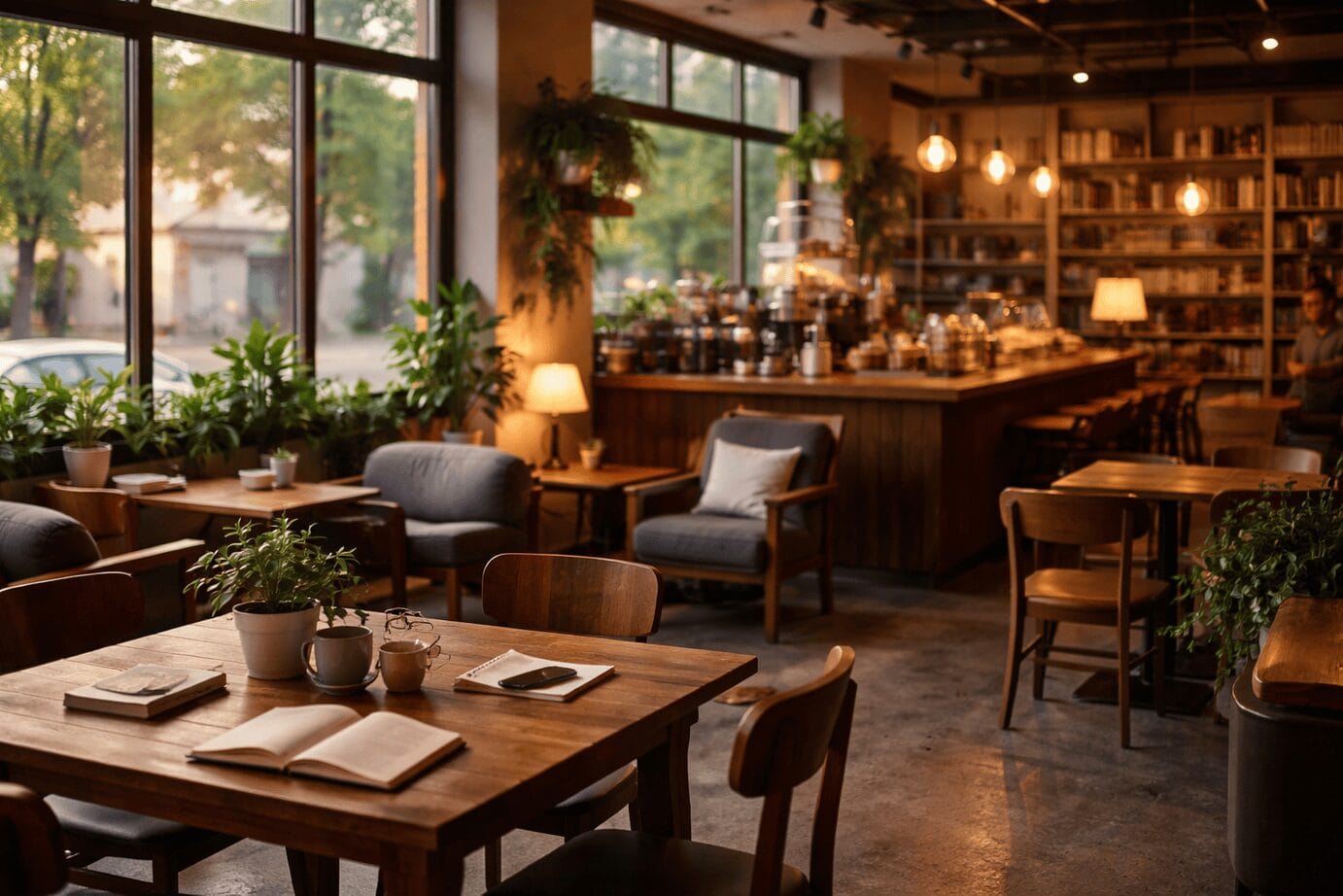
There is a particular kind of magic that happens when a stranger becomes a familiar face, and a familiar face becomes something close to a friend — not because you sought them out, but because life kept putting you in the same room. A barbershop on a Tuesday morning. A corner café where the barista already knows your order. A library reading room where the same retired schoolteacher sits by the window every afternoon. These are not accidents. They are the product of a specific kind of place — one that sociologist Ray Oldenburg spent decades championing — and they are quietly vanishing from the fabric of modern life.
The concept has a name: third places. And understanding what they are, why they matter, and what happens when they disappear may be one of the most urgent conversations of our time.
What Are Third Places?
In his landmark 1989 book The Great Good Place, Oldenburg defined third places as the informal public spaces that anchor community life outside of the home (the first place) and the workplace (the second place). Third places in communities are the neutral ground where people of different backgrounds, ages, and circumstances regularly gather, engage, and simply exist together without agenda or transaction.
Think of the classic examples: the English pub, the Viennese coffeehouse, the French café, the American barbershop, the town square, the corner diner. These are spaces where conversation flows freely, where no one needs an invitation, where the price of admission is low or nonexistent, and where the mood is reliably playful and easy. Oldenburg identified eight defining characteristics of true third places: they are neutral ground, they serve as a leveler, conversation is the main activity, they are accessible and accommodating, they have regulars, they maintain a low profile, the mood is playful, and they feel like a home away from home.
What makes third places in communities so remarkable is not any single quality but the combination of all of them. They are places where a plumber and a professor might share a table. Where nobody checks your credentials at the door. Where you can sit for two hours with a single cup of coffee and no one will ask you to leave.
The Slow Erosion of Community Gathering Spaces
For most of human history, community gathering spaces were built into the structure of daily life by necessity. You went to the market to buy food and you stayed to talk. You went to the well and you exchanged news. The geography of everyday existence forced regular, low-stakes contact with your neighbors, and out of that contact grew something invaluable: the loose, lateral bonds that hold communities together.
The 20th century began dismantling this architecture piece by piece. Suburban sprawl spread populations thin across landscapes designed around the automobile, making accidental encounter increasingly rare. The rise of the shopping mall replaced authentic community gathering spaces with commercialized facsimiles — places optimized for purchasing rather than lingering. The advent of television, and later the internet and smartphones, gave people an alternative to leaving the house altogether.
By the early 2000s, political scientist Robert Putnam was already documenting the consequences in his seminal work Bowling Alone, tracking the steep decline of civic participation, club membership, and informal socializing across American life. The numbers told a story of accelerating social atomization — a world where people were physically closer to more people than ever before but meaningfully connected to fewer and fewer of them.
The pandemic years between 2020 and 2022 compressed this trend into a concentrated crisis. Cafés, libraries, barbershops, community centers — the remaining third places in communities that people still relied on — were shuttered overnight. What had been a slow erosion became a sudden rupture, and many of those spaces never reopened.
The Loneliness Epidemic and the Case for Public Spaces for Socializing
In 2023, U.S. Surgeon General Vivek Murthy issued an advisory calling loneliness a public health epidemic of staggering proportions. He cited research showing that lacking social connection carries health risks comparable to smoking 15 cigarettes a day, that it increases the risk of heart disease, stroke, and dementia, and that it is associated with higher rates of anxiety, depression, and premature death. This was not a fringe finding. The research behind it had been accumulating for decades.
What the advisory made clear is that the loneliness epidemic is not simply a problem of individual psychology. It is a structural problem — a problem of missing infrastructure. And public spaces for socializing are precisely the infrastructure that has been allowed to decay.
When third places in communities exist and function well, they do something that cannot be replicated by a Zoom call or a social media feed: they create the conditions for what sociologists call “weak ties.” These are not your close friends or your family. They are the acquaintances, the regulars, the familiar strangers — the people you recognize from around the neighborhood and exchange a few words with at the coffee counter. Research consistently shows that weak ties are among the most powerful predictors of well-being, mental health, and even economic mobility. They are the connective tissue of community life, and they are almost exclusively produced by repeated, low-stakes physical presence in shared spaces.
Public spaces for socializing give people the opportunity to form these ties without the social overhead of planning a dinner party or joining a formal organization. The encounter happens incidentally, organically, without anyone having to initiate it with intention. That frictionlessness is not a minor detail — it is the entire mechanism.
What Third Places in Communities Actually Do for People
Beyond the measurable health benefits, third places in communities perform a set of social functions that are difficult to overstate and easy to take for granted until they are gone.
They create belonging for people who might otherwise have none. The regular at the local diner who has no family nearby. The immigrant who finds a community around a shared language in the back of a neighborhood café. The elderly widower whose only daily conversation happens with the librarian. For these people, third places are not supplemental to social life — they are social life.
They also serve as informal forums for civic life. Before the formalization of town hall meetings and neighborhood associations, people worked out the shape of their communities over coffee and beer and the creak of a barbershop chair. They shared information, aired grievances, celebrated milestones, and formed the collective identity that makes a neighborhood feel like a neighborhood rather than a zip code.
Social connection and belonging do not emerge from abstract infrastructure. They emerge from repeated, unglamorous, human-scaled contact — the kind that third places in communities are uniquely designed to facilitate. A community with robust third places is not just a happier community; it is a more resilient one, more capable of organizing in a crisis, more capable of caring for its vulnerable members, more capable of sustaining the informal mutual aid that no government program can fully replicate.
The Modern Landscape: What’s Left and What’s at Risk
Not all is lost. In many cities and towns, third places still exist and even thrive. Independent coffee shops in walkable urban neighborhoods have proven surprisingly durable, sustained by a generation of young professionals who are willing to pay a premium for the experience of working and socializing outside the home. Public libraries have reinvented themselves as community hubs, offering programming, meeting rooms, and an explicitly welcoming posture toward anyone who walks through the door regardless of whether they intend to check out a book. Parks, farmers markets, community gardens, and recreational leagues continue to function as community gathering spaces for millions of people.
But access to these spaces is deeply unequal. Walkable neighborhoods with independent cafés and well-funded libraries are disproportionately concentrated in wealthy, urban areas. In lower-income communities, in rural areas, and in the vast swaths of suburban America built after World War II, the third place landscape is often barren. The local diner has been replaced by a drive-through. The library is underfunded and barely open. The park lacks maintenance. The barbershop is still there, but the strip mall around it is half-empty.
The economics of third places are also under sustained pressure. Rent costs in urban areas have made it increasingly difficult for the kind of low-margin, high-dwell-time businesses that function as third places — cafés, bookshops, bars — to survive. The business model of a place where you are welcome to sit for two hours over a single drink is increasingly incompatible with the cost of commercial real estate in the cities where the need for social connection and belonging is most acute.
Designing Third Places Back Into Our Lives
There is a growing recognition among urban planners, public health officials, architects, and community organizers that restoring third places in communities requires deliberate effort. The conditions that once produced them organically — dense, walkable neighborhoods, limited entertainment alternatives, economies of scale that made small neighborhood businesses viable — no longer exist in most of the places where people live. If third places are going to exist at the scale that human well-being requires, they are going to have to be designed and subsidized and protected.
Some cities have begun to take this seriously. Community land trusts have been used to create permanently affordable commercial space for neighborhood-serving businesses. Parks departments have invested in programming and amenities that attract regular use rather than just passive presence. Libraries have been redesigned and repositioned as genuine community centers. New housing developments have been required to include publicly accessible ground-floor spaces.
Loneliness epidemic solutions are also emerging from the private sector and civil society. The “third place” concept has been explicitly embraced by chains like Starbucks — with mixed results, as a commercial third place carries the implicit expectation of ongoing consumption in ways that authentic ones do not. More promising are the community-owned models: the cooperatively run café, the neighborhood association-funded community room, the faith community whose fellowship hall is open to the neighborhood.
Individual choices matter too. Choosing to do your work at a local coffee shop rather than at home, becoming a regular somewhere rather than rotating through options, joining a recreational league or a book club or a community garden — these are not just lifestyle decisions. They are decisions to participate in and sustain the social infrastructure that everyone around you also depends on.
Third Places in the Digital Age
It would be incomplete to discuss third places in communities without acknowledging the internet’s complicated relationship to the concept. Online spaces — forums, Discord servers, social media communities — can and do provide some of what physical third places offer: a sense of belonging, regular contact with familiar faces, easy conversation. For people with disabilities, social anxiety, or limited geographic access to physical spaces, online communities can be genuinely life-giving.
But the research is fairly consistent in suggesting that online interaction does not produce the same benefits as in-person contact, particularly when it comes to well-being and the formation of weak ties. The serendipity that characterizes the best third places — the unexpected conversation, the chance encounter with someone outside your usual social circle — is largely absent from digital spaces, which are organized by algorithm to connect you with people who are already like you.
Third places in communities are heterogeneous by nature. They bring together people who would not otherwise seek each other out. That friction, that exposure to difference, is not incidental to their social function — it is central to it. It is where tolerance is practiced, where empathy is built, where the abstract idea of a community becomes something tangible and lived.
Bringing Third Places Back
The revival of third places in communities is not a nostalgic project. It is not about recreating a past that was, in many ways, exclusionary and imperfect. The classic third places of previous centuries were often spaces of male privilege, racial segregation, and social homogeneity. The third places worth building now are ones that are genuinely open to everyone — that are accessible across income levels, welcoming across demographics, designed with the full range of community members in mind.
What is worth preserving from the tradition is the underlying insight: that human beings need regular, low-stakes, in-person contact with people outside their immediate social circle; that this contact produces health, resilience, and belonging; and that it does not happen by accident in a world organized around cars and screens and private spaces. It has to be built into the landscape of daily life.
Social connection and belonging are not luxuries. They are not amenities for the affluent or the extroverted. They are fundamental needs, as basic as food and shelter, and the infrastructure that meets them deserves to be treated with the same seriousness that we bring to roads, water systems, and power grids.
Third places in communities are that infrastructure. They always have been. The question is whether we are willing to recognize them as such, and to invest in them accordingly — before the last corner café closes, and the last library cuts its hours, and the last familiar stranger becomes a face we never got to know.
Sources and Further Reading
- Oldenburg, Ray. The Great Good Place: Cafés, Coffee Shops, Community Centers, Beauty Parlors, General Stores, Bars, Hangouts, and How They Get You Through the Day. Da Capo Press, 1989. https://www.dacapopress.com/titles/ray-oldenburg/the-great-good-place/9781569246818/
- Putnam, Robert D. Bowling Alone: The Collapse and Revival of American Community. Simon & Schuster, 2000. https://bowlingalone.com
- Murthy, Vivek H. “Our Epidemic of Loneliness and Isolation: The U.S. Surgeon General’s Advisory on the Healing Effects of Social Connection and Community.” Office of the U.S. Surgeon General, 2023. https://www.hhs.gov/sites/default/files/surgeon-general-social-connection-advisory.pdf
- Klinenberg, Eric. Palaces for the People: How Social Infrastructure Can Help Fight Inequality, Polarization, and the Decline of Civic Life. Crown, 2018. https://www.penguinrandomhouse.com/books/557044/palaces-for-the-people-by-eric-klinenberg/
- Granovetter, Mark S. “The Strength of Weak Ties.” American Journal of Sociology, vol. 78, no. 6, 1973. https://www.jstor.org/stable/2776392
- Cacioppo, John T., and William Patrick. Loneliness: Human Nature and the Need for Social Connection. W. W. Norton & Company, 2008. https://wwnorton.com/books/Loneliness/
- Project for Public Spaces. “What Is Placemaking?” https://www.pps.org/article/what-is-placemaking
More from The Daily Mesh:
- Friction Maxxing: The Counterintuitive Path to Building Better Digital Products
- The Untold Mysteries of Mount Kailash Sacred Peak
- Top Remote Skills to Learn in 2025: The Ultimate Guide to Thriving in a Digital Workforce