


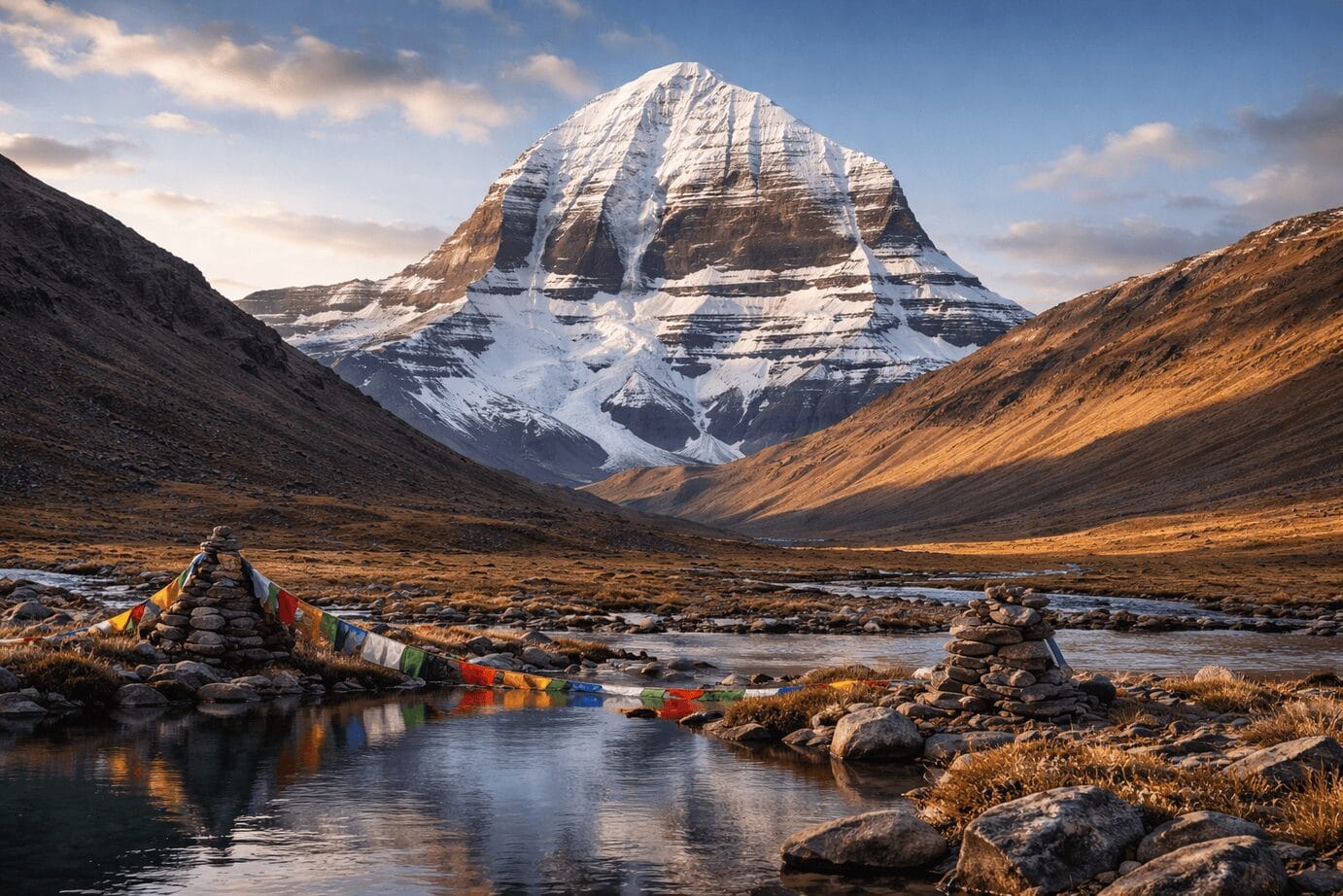
Standing majestically at 6,638 meters above sea level in the remote western reaches of the Tibetan Plateau, the Mount Kailash sacred peak commands reverence from millions of devotees across the globe. This diamond-shaped mountain, formed by black conglomerate rocks and crowned with eternal snow, represents far more than a geographical landmark. It embodies the spiritual aspirations of four major world religions and remains one of the most enigmatic destinations on Earth.
The Geographical Marvel
The Mount Kailash sacred peak rises in the Gangdise Shan mountain range, part of the Trans-Himalayan system in the Tibet Autonomous Region of China. Located near the western trijunction where China, India, and Nepal converge, this extraordinary mountain occupies a position of tremendous geographical significance. Its coordinates place it at 31.0675° N latitude and 81.3119° E longitude within Burang County in the Ngari Prefecture.
What makes this location particularly remarkable extends beyond its elevation. The region surrounding the Mount Kailash sacred peak serves as the source of four of Asia’s longest and most important rivers. The Indus, Sutlej, Brahmaputra, and Karnali rivers all begin their journey within a 60-kilometer radius of the mountain, bringing life to millions of people across the Indian subcontinent. This hydrological significance has contributed to the mountain’s reputation as a life-giving force.
The mountain’s distinctive pyramidal shape sets it apart from neighboring peaks. Unlike the jagged, irregular formations typical of the Himalayas, this sacred mountain displays an almost perfectly symmetrical structure with four distinct faces aligned precisely with the cardinal directions. Each face presents unique geological features and spiritual meanings that have captivated pilgrims and explorers for millennia.
Lake Manasarovar, one of the highest freshwater lakes in the world at 4,588 meters above sea level, lies at the foot of this majestic peak. Spanning 320 square kilometers, this turquoise jewel adds to the region’s spiritual magnetism. Adjacent to it sits Lake Rakshastal, a saltwater body that forms a cosmic balance with Manasarovar, representing the eternal interplay between light and darkness in spiritual philosophy.
Sacred Significance Across Four Religions
The spiritual importance of the Mount Kailash sacred peak transcends geographical and cultural boundaries, uniting diverse religious traditions in their veneration of this extraordinary mountain. Understanding why millions undertake arduous journeys to reach this remote destination requires exploring the unique perspectives each faith brings to the pilgrimage.
Hinduism: The Abode of Lord Shiva
For Hindus worldwide, the Mount Kailash sacred peak represents the earthly dwelling of Lord Shiva, the deity of destruction and transformation who sits in eternal meditation alongside his consort Parvati. Ancient Hindu texts describe the mountain as the axis of the universe, a cosmic pillar supporting the celestial realms. The Puranas elaborate that each face comprises different precious materials: crystal for the south, ruby for the west, gold for the north, and lapis lazuli for the east.
Hindu pilgrims believe that circumambulating the mountain washes away the sins of an entire lifetime and advances them closer to moksha, the liberation from the cycle of birth and death. Many devotees report experiencing profound spiritual transformations during their journey, claiming to glimpse the divine presence in the mountain’s changing faces throughout the day. The southern face, visible from Darchen, particularly captures pilgrims’ imagination as its rock formations suggest the third eye of Lord Shiva.
Buddhism: The Cosmic Center
Tibetan Buddhists know the Mount Kailash sacred peak as Gang Rinpoche, meaning “precious jewel of snow,” and identify it with Mount Meru, the mythological center of the universe in Buddhist cosmology. They believe Buddha Demchok, also called Cakrasamvara, who represents supreme bliss and enlightenment, resides on this mountain. The legendary Buddhist yogi Milarepa holds special significance here, as tradition claims he alone achieved the summit through supernatural means after defeating a Bon practitioner in a magical contest for control of the mountain.
Buddhist pilgrims perform their circumambulation clockwise, chanting mantras and spinning prayer wheels as they traverse the challenging terrain. The most devoted practitioners undertake the journey through full-body prostrations, a method requiring three weeks to complete the circuit. This extreme form of devotion demonstrates the depth of spiritual commitment Buddhists associate with the Mount Kailash sacred peak.
Jainism: Path to Liberation
Jains revere this mountain as Mount Ashtapada, the “Mountain of Eight Steps,” where Rishabhadeva, the first Tirthankara of Jainism, attained nirvana and liberation from worldly existence. According to Jain scriptures, after Rishabhadeva achieved moksha, his son Emperor Bharata Chakravartin constructed three stupas and twenty-four shrines studded with precious stones in the region. These monuments honored all twenty-four Tirthankaras, though they no longer exist in physical form today.
For Jain pilgrims, visiting the Mount Kailash sacred peak represents the ultimate spiritual journey, connecting them directly to their faith’s foundational moments. The pilgrimage embodies the Jain principles of non-violence, truthfulness, and spiritual asceticism, as practitioners endure physical hardships to reach this sacred destination.
Bon Religion: The Ancient Foundation
The indigenous Bon religion of Tibet predates Buddhism in the region and maintains its own profound connection to the Mount Kailash sacred peak. Bonpo practitioners call it Yungdrung Gutsek, the “Nine-Story Swastika Mountain,” and consider it the seat of all spiritual power. They believe Tonpa Shenrab Miwoche, the founder of their religion, descended from heaven to this mountain.
Unlike practitioners of the other three religions, Bonpo pilgrims circumambulate the mountain counterclockwise, following their tradition’s unique ritual practices. For them, the mountain represents the sky goddess Sipaimen and serves as the primary focus of tantric rituals and ceremonies. The Bon tradition views the Mount Kailash sacred peak as the source of cosmic energy that radiates throughout the spiritual realm.
The Kailash Parikrama: A Journey of Transformation
The circumambulation of the Mount Kailash sacred peak, known as Kailash Parikrama in Hindi or Kora in Tibetan, forms the central ritual of pilgrimage to this sacred mountain. This 52-kilometer circuit takes pilgrims through some of the most challenging terrain in the Himalayas, testing both physical endurance and spiritual resolve.
The journey typically begins and ends at Darchen, a small settlement at 4,670 meters elevation that serves as the base camp for pilgrims. Most complete the circuit in three days, though the physically fit may accomplish it in two, while those performing prostrations require several weeks. The path leads through dramatic landscapes featuring stark mountain vistas, glacial valleys, prayer flag-festooned passes, and ancient monasteries that have witnessed countless pilgrims over centuries.
Day one covers approximately 14 kilometers from Darchen to Dirapuk Monastery, ascending gradually through the Lha-chu Valley. This section offers spectacular views of the north face of the Mount Kailash sacred peak, particularly striking during sunrise when the sun casts golden light across the mountain’s crystalline slopes. Pilgrims settle for the night at basic guesthouses near the monastery, preparing themselves mentally and physically for the challenging day ahead.
The second day presents the trek’s most demanding segment, climbing to Dolma La Pass at 5,650 meters before descending to Zutulphuk Monastery. This 19-kilometer stretch requires approximately 10-12 hours and tests even seasoned trekkers. At Dolma La, pilgrims pause to offer prayers, leave personal tokens, and absorb the profound spiritual energy believed to permeate this high point. Many report experiencing overwhelming emotions, breakthrough insights, or mystical visions at the pass.
The final day brings a relatively easier 12-kilometer descent back to Darchen, completing the sacred circle around the Mount Kailash sacred peak. Pilgrims emerge from this journey transformed, carrying memories and spiritual insights they will treasure throughout their lives. The physical challenges mirror the internal obstacles each seeker confronts on their path toward enlightenment.
The Mystery of an Unclimbed Peak
Perhaps nothing enhances the mystique of the Mount Kailash sacred peak more than its status as an unclimbed mountain. While peaks across the Himalayas have felt the crampons of countless mountaineers, including the formidable Mount Everest, this sacred mountain remains untouched by human feet at its summit. Several factors contribute to this unique distinction.
First and foremost, the Chinese government officially banned all climbing attempts on the mountain in 2001, recognizing and respecting its profound religious significance to millions of believers across Asia and beyond. This legal prohibition reflects the understanding that some places transcend sporting conquest and deserve preservation in their pristine, sacred state.
Beyond legal restrictions, the spiritual beliefs surrounding the mountain create powerful psychological barriers. Indigenous Tibetans and devoted pilgrims from all four religions believe that attempting to climb the Mount Kailash sacred peak would constitute a grave sacrilege, inviting cosmic retribution and spiritual catastrophe. Even Western mountaineers who might not share these beliefs often choose to honor the cultural sensitivities of the region’s inhabitants.
The most famous climbing proposal came from Spanish mountaineer Jesús Martínez Novás, who received permission from the Chinese government in 2001. However, massive international protests from religious groups worldwide, particularly from India, forced authorities to rescind the permit. This incident demonstrated the mountain’s unique position as a unifying sacred site that transcends political boundaries and national interests.
Some traditions claim that the Buddhist saint Milarepa remains the only person to have reached the summit, accomplishing this feat through supernatural means rather than physical climbing. This legend reinforces the belief that the mountain exists on a plane beyond ordinary human achievement, accessible only to those who have transcended mortal limitations through spiritual perfection.
Mysterious Phenomena and Scientific Intrigue
The Mount Kailash sacred peak has attracted attention from researchers and scientists intrigued by various unexplained phenomena reported by visitors to the region. While maintaining scientific skepticism, these accounts add another layer of fascination to an already captivating destination.
One of the most frequently reported observations involves accelerated aging near the mountain. Numerous pilgrims and visitors claim that spending just 12 hours in the vicinity causes hair and nails to grow as much as they typically would over two weeks. While no conclusive scientific explanation exists for this phenomenon, it has sparked theories about unique energy fields, atmospheric conditions, or other environmental factors specific to the region.
The mountain’s alignment with other sacred sites worldwide has captured the imagination of researchers exploring ancient geometry and earth energy systems. The distance from Mount Kailash to Stonehenge measures precisely 6,666 kilometers, the same distance that separates it from the North Pole. More remarkably, the distance to the South Pole equals 13,332 kilometers, exactly double the distance to Stonehenge or the North Pole. These mathematical relationships, combined with the mountain’s position relative to other ancient sacred sites like the Egyptian pyramids and Easter Island, suggest to some researchers that ancient civilizations possessed sophisticated geographical knowledge.
Satellite imagery has revealed intriguing patterns on the mountain’s faces. Some observers claim the shadow formations on the north face resemble the countenance of Lord Shiva, complete with discernible features suggesting eyes, nose, and mouth. While pareidolia might explain these patterns as the human tendency to recognize faces in random formations, the striking nature of these images continues to fascinate believers and skeptics alike.
The geological composition of the Mount Kailash sacred peak itself presents interesting questions. The mountain consists of thick conglomerate rocks sitting atop granite foundations, with the visible conglomerates extending from approximately 4,700 meters to the summit. The symmetrical, pyramidal shape appears almost artificial, leading some theorists to speculate about ancient constructions or interventions, though mainstream geology attributes the formation to natural erosional processes over millions of years.
Planning Your Pilgrimage
Undertaking a journey to the Mount Kailash sacred peak requires careful preparation, both spiritual and practical. The remote location, high altitude, and challenging conditions demand respect and thorough planning to ensure a safe and meaningful experience.
Physical Preparation
The high altitude presents the primary challenge for visitors. The trek around the mountain averages nearly 5,000 meters elevation, with the Dolma La Pass exceeding 5,600 meters. Altitude sickness poses a real danger that requires proper acclimatization. Most itineraries include several days of gradual ascent, allowing the body to adjust to reduced oxygen levels. Physical training should begin months before departure, focusing on cardiovascular endurance and leg strength.
Required Documentation
Visiting the Mount Kailash sacred peak requires several permits and documents. Foreign travelers must obtain a Tibet Travel Permit, Alien’s Travel Permit, and Military Permit. Indian citizens can participate in official Kailash Mansarovar Yatra organized by the Indian government through selection processes, or they can join private tours through registered travel companies. These expeditions must be arranged through authorized tour operators, as independent travel to the region remains prohibited.
Best Time to Visit
The pilgrimage season runs from May through September, when weather conditions are most favorable. During these months, day temperatures range from 5 to 17 degrees Celsius, though nights can drop to freezing. June through August represents peak season when the Mount Kailash sacred peak sees the highest number of pilgrims. However, this popularity means crowded trails and limited accommodation. May and September offer excellent alternatives with fewer visitors but slightly less predictable weather.
Winter months from October through April bring extreme conditions with temperatures plummeting to minus 20 degrees Celsius at night. Heavy snowfall can block passes and make the circumambulation dangerous or impossible. The region essentially closes to tourism during this period.
Route Options
Several routes lead to the Mount Kailash sacred peak, each offering unique experiences. The most popular approach from Nepal begins in Kathmandu, proceeding to the Tibetan border at Kyirong, then continuing overland through Saga to Lake Manasarovar and finally Darchen. This route typically requires 12-15 days for the complete journey.
Starting from Lhasa provides better altitude acclimatization through gradual ascent. This route passes through Gyantse and Shigatse, often including a detour to Everest Base Camp, before reaching the western regions. Though longer, requiring 18-22 days, it reduces altitude sickness risk and allows deeper cultural immersion in Tibetan regions.
Indian pilgrims can access the area through the Lipulekh Pass in Uttarakhand, following ancient pilgrimage routes that have connected India to this sacred site for millennia. This option requires special permits and typically forms part of government-organized yatras.
Essential Gear
Proper equipment significantly impacts the pilgrimage experience. Layered clothing systems prove essential for managing the dramatic temperature fluctuations between sunny afternoons and freezing nights. Quality trekking boots provide crucial ankle support and protection on rocky, uneven terrain. Sleeping bags rated for sub-zero temperatures ensure comfort at high-altitude accommodations where heating may be minimal.
Trekking poles assist with balance and reduce strain on knees during steep descents. Sunglasses and high-SPF sunscreen protect against intense ultraviolet radiation at altitude, where the thin atmosphere provides less filtering. Water purification tablets or filters ensure safe drinking water throughout the journey. Basic medications for altitude sickness, digestive issues, and minor injuries should form part of every pilgrim’s first aid kit.
Lake Manasarovar: The Sacred Waters
No pilgrimage to the Mount Kailash sacred peak would be complete without visiting Lake Manasarovar, the pristine freshwater lake that Hindus and Buddhists consider among the holiest water bodies on Earth. Created from the thoughts of Brahma according to Hindu tradition, the lake offers opportunities for ritual bathing believed to cleanse devotees of lifetimes of accumulated karma and sins.
The lake’s stunning turquoise waters reflect the surrounding snow-capped peaks, creating scenes of breathtaking natural beauty that complement the spiritual atmosphere. Pilgrims typically spend at least one full day at the lake, performing prayers, meditation, and ceremonial baths along its shores. Several ancient monasteries ring the lake, including Chiu Gompa perched dramatically on a hilltop overlooking the water.
In contrast, Lake Rakshastal nearby represents the darker aspects of spiritual existence. This saltwater lake, associated in Hindu mythology with the demon king Ravana, forms a cosmic balance with Manasarovar. Together, these lakes embody the perpetual interplay between positive and negative forces, light and darkness, that characterizes the human spiritual journey.
Cultural Sensitivity and Environmental Responsibility
Visiting the Mount Kailash sacred peak brings responsibilities toward both the religious communities who revere this site and the fragile Himalayan ecosystem. Pilgrims should observe several important principles to ensure their journey honors local customs and preserves the environment for future generations.
Dress modestly and behave respectfully, especially around monasteries and during religious ceremonies. Photography inside temples usually requires permission, and some sacred sites prohibit cameras entirely. Always walk clockwise around stupas, chortens, and mani stones unless following the Bon tradition of counterclockwise circumambulation.
Environmental protection has become increasingly urgent as tourism increases. Carry out all trash generated during the trek, never leaving waste along the trail. Human waste disposal requires special attention at high altitudes where decomposition occurs slowly. Use designated toilet facilities where available, or dig cat holes far from water sources when facilities are absent.
Minimize campfire use, as firewood remains scarce in these high-altitude regions. Most trekking companies now bring portable cooking fuel, eliminating the need to harvest local vegetation. Respect wildlife, maintaining safe distances from any animals encountered along the route.
The Transformative Power
Those who complete the journey to the Mount Kailash sacred peak universally describe it as transformative, regardless of their religious background or spiritual beliefs. The combination of physical challenge, cultural immersion, and profound natural beauty creates an experience that transcends ordinary tourism, touching something fundamental in the human spirit.
Many pilgrims report experiencing clarity about life direction, resolution of internal conflicts, or deep insights into questions that have troubled them for years. The stripped-down simplicity of life on the trail, the shared purpose among fellow pilgrims, and the overwhelming presence of the mountain itself combine to create conditions conducive to breakthrough moments and spiritual awakening.
The Mount Kailash sacred peak stands as a testament to humanity’s eternal quest for meaning beyond the material world. In an age dominated by technology, distraction, and constant connectivity, this remote mountain offers something increasingly rare: a place where the spiritual dimension of existence remains paramount, where ancient practices continue unchanged, and where seekers can connect with traditions stretching back thousands of years.
Whether one approaches as a devout pilgrim seeking religious merit, an adventure traveler drawn to unique destinations, or a spiritual seeker exploring various traditions, the Mount Kailash sacred peak offers experiences available nowhere else on Earth. This remarkable mountain continues to guard its mysteries while welcoming those humble enough to approach with reverence, strong enough to endure the journey, and open enough to receive whatever teachings it chooses to impart.
The pilgrimage to the Mount Kailash sacred peak represents more than a journey through physical space. It becomes a passage through inner landscapes, a confrontation with personal limitations, and ultimately, a homecoming to dimensions of existence that modern life often obscures. Those who hear the mountain’s call and answer it discover that the arduous journey to Tibet’s remote western reaches yields rewards far beyond anything imagined when they first set out. The mountain waits, eternal and unchanging, ready to transform all who approach with sincerity and devotion.
More from The Daily Mesh:
- The Life of Giorgio Armani: A Timeless Journey of Fashion and Elegance
- Top 10 Best Walking Pad Under-Desk Treadmills You Can Buy Today
- Bangladesh Air Force Jet Crash Tragedy: Over 30 Dead Including Innocent School Children