


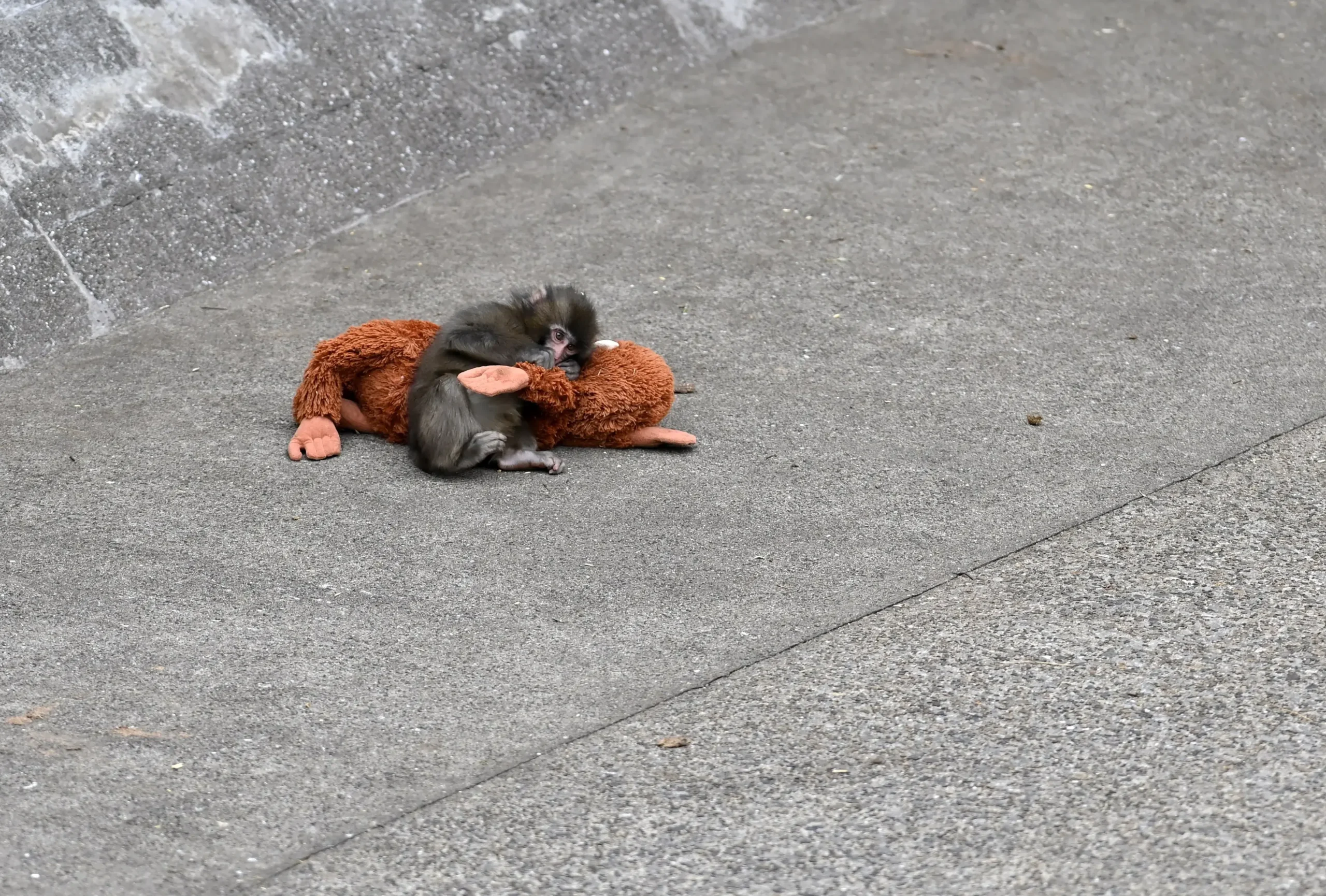
A Tiny Monkey, a Stuffed Toy, and a World That Needed Something to Root For
Some stories arrive at exactly the right time. In February 2026, the internet found itself collectively, almost desperately, rooting for a baby snow monkey in a small zoo east of Tokyo. His name was Punch. He was barely seven months old. He had been abandoned by his mother, rejected by his troop, and left to navigate a world he hadn’t asked to be born into — clutching a stuffed orangutan toy as his only source of comfort.
Punch the monkey didn’t set out to become a global phenomenon. He was just a small animal doing the only thing he knew how to do: hold on. And somehow, in doing exactly that, he reached millions of people around the world who understood the feeling more deeply than they expected.
This is his story.
Born at Ichikawa City Zoo
Punch the monkey was born on July 26, 2025, at the Ichikawa City Zoo and Botanical Gardens in Ichikawa, Chiba Prefecture — a city that sits just east of Tokyo, close enough to be a day trip from the capital but small enough to be easily overlooked on a tourist map. The zoo itself is a modest, community-focused institution operated by Ichikawa City, with a mission centered on education, conservation, and animal welfare.
He was named after Monkey Punch, the beloved manga artist who created the iconic Lupin the Third series. It’s a warm tribute that speaks to the affection Japanese culture holds for both the macaque species and the playful spirit the name suggests.
But the warmth of the name stood in sharp contrast to what happened immediately after his birth. Punch’s mother showed no interest in raising him. Within a day of being born, the infant was abandoned — left without the warmth, nutrition, or social contact that baby macaques depend on completely in their earliest weeks of life.
Zookeepers intervened immediately. Two dedicated caretakers began hand-raising Punch, bottle-feeding him milk and providing the physical closeness that his mother had not. It was a significant commitment — baby macaques require constant care and proximity — and those early weeks shaped everything that would follow.
The Stuffed Orangutan That Became “Oran Mama”
For a baby macaque, the relationship with a maternal figure isn’t merely emotional. It’s developmental. Young Japanese macaques cling to their mothers almost constantly in the first months of life, using that physical connection to regulate their body temperature, learn social cues, and build the neural pathways that underpin healthy behavior within a troop.
Without that maternal figure, Punch needed something to cling to. Zookeepers gave him a large, soft stuffed orangutan toy. What happened next was both entirely practical and quietly heartbreaking. Punch adopted the toy completely. He carried it with him everywhere. He slept with it. He dragged it across the enclosure floor. When other monkeys approached, he held on tighter.
Visitors to the zoo began filming these moments and sharing them online. The stuffed orangutan quickly earned its own nickname from fans who watched: “Oran Mama,” or “Oran Mother.” The name captured something real — the toy wasn’t just a comfort object. For Punch, it was the closest thing he had to a parent.
Zoo staff have been meticulous about caring for Oran Mama as seriously as they care for Punch himself. The plush toy he sleeps with each night is washed every morning. When IKEA Japan learned of the story, they donated eleven additional stuffed orangutans to the zoo, ensuring Punch would always have a clean, fresh surrogate waiting. There are now multiple Oran Mamas in rotation — a detail that the internet found equal parts practical and unbearably sweet.
Integration and the Struggle to Belong
In January 2026, when Punch was approximately six months old, zookeepers made the decision to integrate him into the main macaque enclosure — a habitat known as Monkey Mountain, home to roughly 60 Japanese macaques. It was a necessary step. Macaques are highly social animals, and a life lived apart from the troop carries serious consequences for long-term behavioral development.
But integration, as anyone who has ever been the new kid can understand, is rarely smooth. Punch the monkey had grown up without the social scaffolding that naturally-raised macaques develop from birth. He didn’t know the unwritten rules of the group. He didn’t understand the hierarchy, the rituals, the subtle signals that govern daily life within a macaque community. The result was visible distress. Zookeepers observed clear signs of anxiety and isolation in Punch during the early weeks of integration.
Videos from this period are difficult to watch. Punch can be seen wandering the edges of the enclosure alone, clutching Oran Mama, being chased off by older monkeys, or sitting by himself while the rest of the troop moves and interacts around him. The hashtag #HangInTherePunch — in Japanese, #がんばれパンチ — began circulating online as viewers worldwide willed him toward acceptance.
It is worth noting here what zookeepers have said clearly and repeatedly: the scolding that Punch received from other monkeys was not cruelty. It was communication. In macaque social groups, scolding is how boundaries are established and social order is taught. The older monkeys were not rejecting Punch permanently. They were teaching him. The process looked harsh from the outside, but it was, in the language of macaque society, education.
The Post That Changed Everything
On February 5, 2026, the Ichikawa City Zoo posted an update about Punch’s situation on social media. They shared his backstory — the abandonment, the hand-raising, the integration struggles, the stuffed toy companion — in straightforward, honest terms. They didn’t dramatize it. They didn’t sensationalize it. They simply told the truth about a small monkey who was having a hard time finding his place.
The post became an overnight sensation.
Within hours, images of Punch the monkey with Oran Mama had spread across Japanese social media and then beyond — to global platforms, international news outlets, and the feeds of millions of people who had never heard of Ichikawa City Zoo before that morning. The #HangInTherePunch hashtag trended across multiple platforms. Fan art appeared. Comment sections filled with messages of encouragement addressed directly to a baby macaque who would never read them.
Zoo officials were unprepared for the scale of the response. Unprecedented lines began forming outside the zoo gates. Visitor numbers surged in ways the small institution had never experienced. Officials were moved to apologize publicly for the wait times and congestion that Punch’s sudden fame had created. Entry restrictions and parking closures had to be implemented to manage crowd flow and, importantly, to protect the animals themselves from the stress of overwhelming visitor numbers.
In the span of a single week, a quiet local zoo had become one of the most-talked-about destinations in Japan.
Signs of Progress: Grooming, Play, and Growing Acceptance
The story of Punch the monkey could easily have remained one of pure heartbreak — a small animal struggling indefinitely on the margins of a group that didn’t fully accept him. But the updates that followed through February 2026 told a different, more hopeful story.
Keepers reported that grooming between Punch and other monkeys was becoming more frequent. Grooming in macaque society is not a casual act. It is an investment of time and attention that signals trust, social bonding, and acceptance. Being groomed by multiple monkeys is a meaningful marker of integration, not just tolerance.
On February 23, a keeper shared that no scolding incidents had been observed that day. Punch had been seen playing with the younger baby monkeys in the troop. During feeding time, he descended from the keeper’s foot on his own initiative and ate independently with the group — a small act of autonomy that represented significant progress for an animal who had spent his early months entirely dependent on human caregivers.
New footage emerged showing Punch staying close to a larger monkey and following it around the enclosure. Zoo officials shared a meaningful observation: this big monkey had accepted Punch, and Punch had completely grown attached. It was exactly the kind of surrogate relationship — with an actual living macaque this time — that the zoo had been hoping for since integration began.
Over the Emperor’s Birthday holiday weekend in late February, more than 6,000 visitors attended on a single day. The lines remained long, the interest showed no sign of fading, and Punch the monkey continued his quiet, daily progress toward belonging.
The Science Behind the Struggle: Japanese Macaque Social Behavior
To fully appreciate what Punch has been going through, it helps to understand a little about how Japanese macaque troops function. Japanese macaques — also called snow monkeys — are among the most studied primates in the world. They live in large, hierarchically structured groups governed by complex social rules that take years to fully internalize.
Infants born into a healthy troop have an enormous advantage: their mothers carry them constantly, their relatives protect them, and they absorb the group’s social norms through continuous observation and gentle correction. They grow up embedded in the social fabric. They know who outranks whom. They know which approaches are welcome and which are not.
Punch had none of that. He was raised by humans, isolated from macaque social dynamics during his most formative months, and then placed into an established group as a stranger. His anxiety and isolation were not character flaws. They were the predictable result of developmental circumstances beyond his control.
The fact that he has made as much progress as he has — finding a larger monkey to attach to, engaging in play, eating independently, being groomed — speaks to the resilience that is also characteristic of the species. Japanese macaques are adaptable animals. Given time, patience, and the right conditions, Punch has every reason to find his footing.
Why Punch Resonated So Deeply
It would be easy to dismiss the global attachment to Punch the monkey as simple cute-animal internet culture — and there is certainly an element of that at work. Baby macaques are objectively charming. A tiny primate dragging a stuffed toy across a zoo enclosure is, on a purely visual level, arresting.
But the depth of the response to Punch’s story goes beyond that. People weren’t just charmed by him. They were moved by him. And the reason, if you look at the messages people left online, the fan art they created, the hashtag they rallied around, is not hard to understand.
Punch’s experience maps onto something recognizably human. Abandonment. The search for comfort in an imperfect substitute. The anxiety of trying to fit into a group whose rules you don’t fully understand. The shame of being scolded in front of others. The tentative, fragile hope that comes when someone — anyone — finally accepts you.
People saw themselves in Punch. They saw children they knew. They saw their own experiences of loneliness and eventual belonging. They rooted for him not just because he was small and soft and photogenic, but because his struggle was legible in a language that crosses species lines.
In a period defined by social fragmentation, information overload, and a pervasive sense of disconnection, Punch the monkey offered something rare: an uncomplicated reason to care about something, and the steady, daily reward of watching that something slowly, incrementally, get a little better.
Visiting Punch at Ichikawa City Zoo
For those inspired to make the trip, the Ichikawa City Zoo and Botanical Gardens is accessible from central Tokyo. The zoo is located in Ichikawa, Chiba Prefecture, just east of the capital. It is open Tuesday through Sunday from 9:30 a.m. to 4:30 p.m. (last entry at 4:00 p.m.) and is closed on Mondays and public holidays.
Admission is 440 yen for adults and 110 yen for children — an extraordinarily affordable visit by any measure. Preschool-age children enter free. Group discounts are available for parties of 25 or more with prior reservation. The zoo can be contacted at 047-338-1960 for the most current visitor information (add +81 for Japan’s country code if calling internationally).
Punch lives in the Monkey Mountain enclosure, where visitors can observe him among the wider macaque troop. Zoo officials have issued clear guidance: please don’t tap on enclosure glass, don’t make sudden loud noises, and absolutely do not attempt to call out to, touch, or feed Punch or any of his troop members. Stress is the last thing this particular monkey needs, especially while he is still in the delicate process of building relationships with his companions. The best gift visitors can give him is quiet, respectful observation.
If you make the journey, know that you are visiting at a meaningful moment. Punch the monkey is still writing his story, and showing up — even silently — to cheer him on is part of what makes that story worth telling.
A Story Still Being Written
As of late February 2026, Punch the monkey is still very much a work in progress. Full integration into a macaque troop is not a destination you arrive at — it is an ongoing process, measured in small moments of trust accumulated over time. There will be more scolding. There will be difficult days. There may be setbacks that worry the viewers who have grown attached to his progress.
But the direction is clear, and the signs are encouraging. Grooming. Independent eating. Play with younger troop members. A larger monkey who has, quietly and without ceremony, accepted Punch and let him follow along.
The stuffed Oran Mama is still there, still being washed each morning, still waiting as a comfort when the world feels too large. But she is, day by day, being needed a little less — because Punch is, day by day, finding his place among the living.
That’s all any of us are really doing. And somehow, watching a seven-month-old snow monkey figure it out makes the whole endeavor feel a little more manageable.
#HangInTherePunch.
Sources
- https://en.wikipedia.org/wiki/Punch-kun
- https://www.japantimes.co.jp/news/2026/02/24/japan/punch-monkey-viral/
- https://www.travelpirates.com/captains-log/punch-kun-update-ichikawa-zoo-crowds-february-24
- https://parade.com/travel/how-to-visit-viral-monkey-punch-japan-ichikawa-city-zoo
- https://abc7chicago.com/post/punch-monkey-has-made-friends-ichikawa-zoo-going-viral-social-media-japan/18644996/
- https://batamnewsasia.com/2026/02/24/abandoned-baby-punch-monkey-in-japan-charms-visitors-with-orangutan-plush-companion/
More from The Daily Mesh:
- Behind the Scenes: The Truth About Olympic Village Food
- Climate Science Today: Ice Loss, Heat Domes & AI Forecasting
- The Life of Charlie Kirk: Influence, Achievements, and Controversies