


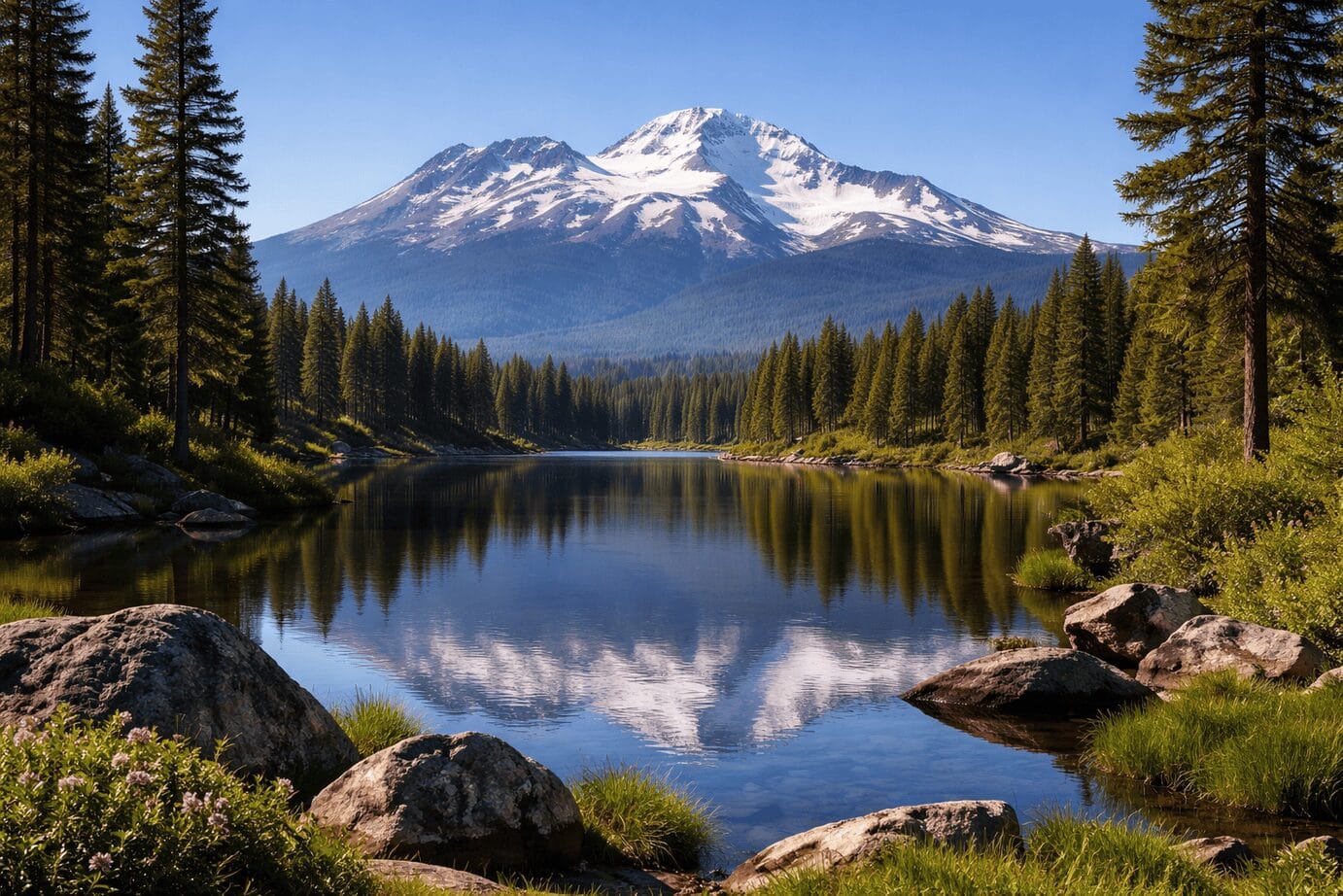
Towering 14,179 feet above Northern California’s landscape, Mount Shasta California commands attention from over 100 miles away. This massive stratovolcano rises in solitary magnificence along Interstate 5, approximately 60 miles south of the Oregon border, yet remains relatively unknown compared to other California landmarks. What makes this geographic giant truly extraordinary isn’t just its physical presence—it’s the convergence of volcanic power, spiritual mysticism, and outdoor adventure that has drawn seekers, climbers, and dreamers for thousands of years.
Unlike the crowded peaks of Yosemite or the tourist-packed trails of Lake Tahoe, Mount Shasta California offers something different. This is a place where ancient Native American traditions blend with modern spiritual movements, where active glaciers carve through volcanic rock, and where over 15,000 climbers each year attempt to reach its summit—with only a third succeeding.
The Geological Marvel: Understanding Mount Shasta’s Volcanic Power
Mount Shasta California stands as the second-highest peak in the Cascade Range and the fifth-highest mountain in California. But raw elevation only tells part of the story. With a base diameter exceeding 17 miles, Mount Shasta California is the most voluminous stratovolcano in the entire Cascade Volcanic Arc, containing an estimated 85 cubic miles of volcanic material.
The mountain began forming between 300,000 and 500,000 years ago on the remnants of an older volcano that collapsed catastrophically. This ancient collapse spawned one of Earth’s largest known landslides, covering more than 440 square kilometers of Shasta Valley to the northeast. Today’s Mount Shasta California is actually a composite of multiple volcanic cones built atop this foundation.
Shastina, the prominent secondary peak visible from Interstate 5, rises to 12,330 feet and is the third-highest summit in the Cascade Range. This massive satellite cone adds to Mount Shasta California’s distinctive profile, creating a multi-peaked silhouette that dominates the northern California skyline.
The volcano remains active, classified by the U.S. Geological Survey as having “Very High” threat potential. Hot springs and volcanic gases seep from the summit area, indicating a relatively young and still-hot magmatic system. The mountain’s eruptive history reveals that over the past 10,000 years, Mount Shasta California has erupted at least once every 600 to 800 years. The last documented eruption occurred around 1786, with increased eruption frequency noted over the past 750 years—approximately once every 250 years.
Seven named glaciers drape Mount Shasta California’s slopes: Whitney, Bolam, Hotlum, Wintun, Watkins, Konwakiton, and Mud Creek. The Whitney Glacier holds the distinction of being California’s longest glacier, while the Hotlum Glacier is the state’s most voluminous. These ice masses primarily occupy the northern and eastern faces, where four major glaciers descend from high elevations to below 10,000 feet. The southern slopes host three smaller glaciers positioned in cirques above 11,000 feet.
These glaciers aren’t just scenic features—they’re dynamic forces still shaping the mountain. Glacial meltwater feeds numerous streams and creates hazards for climbers and nearby communities. The U.S. Geological Survey maintains a network of 12 seismometers and nine GPS receivers around Mount Shasta California to monitor volcanic activity, ground deformation, and potential eruption indicators.
Sacred Ground: The Ancient Spiritual Legacy of Mount Shasta California
Long before Frederick Spencer Oliver wrote about Lemurians or Guy Ballard claimed to meet Count Saint Germain, Mount Shasta California served as sacred ground for Native American peoples. Archaeological evidence traces human occupation around the mountain back approximately 11,000 years to the end of the last Ice Age, making this region one of California’s oldest continuously inhabited areas.
For the Modoc, Shasta, Wintu, Achumawi, and Atsugewi tribes, Mount Shasta California represents far more than a geographic feature. According to Modoc tradition, G’mokumk the creator resided on the mountain, and the original bones of the Modoc people are placed there. The Wintu trace their origins to a sacred spring on Mount Shasta California’s slopes and have performed ceremonies there since time immemorial.
According to local Klamath legends, Mount Shasta California is inhabited by Skell, the spirit chief who descended from heaven to the mountain’s summit. Traditional stories describe epic battles between Skell and Llao, the Spirit of the Below-World who resided at Mount Mazama (now Crater Lake), with the two chiefs hurling hot rocks and lava at each other—likely representing actual volcanic eruptions witnessed by ancient peoples.
Native Americans viewed Mount Shasta California and its surroundings as holy ground, believing it to be one of the first earthly places created by the Great Spirit. A primordial spiritual connection was believed to link Mount Shasta California with other energetically powerful sites throughout the region, including Lassen Peak, Lava Beds, Medicine Lake Highlands, and Crater Lake.
Taylor Tupper, a Modoc Indian raised in the Klamath Basin, explains the continuing reverence: “Shasta is where G’mokumk, the creator, resided and the original bones of the Modoc people are placed. I always bring offerings such as water or tobacco when I visit, because I never want to come to the mountain in a bad way.”
This traditional Native American spiritual connection extends beyond human concerns. The mountain is also considered home to the matah kagmi—the Modoc word for Bigfoot—reflecting the indigenous understanding that Mount Shasta California serves as a nexus point for various forms of life and consciousness.
Modern Mysticism: Lemuria, Ascended Masters, and the I AM Movement
Mount Shasta California’s reputation as a spiritual power center for non-indigenous people didn’t emerge until the 19th century. Naturalist John Muir described the mountain’s peak as a religious icon after his dramatic 1877 overnight survival near the summit’s sulfur springs during a blizzard. His vivid account helped establish Mount Shasta California as a destination for spiritual seekers and adventurers.
The modern mystical reputation of Mount Shasta California can be traced to Frederick Spencer Oliver’s 1905 book “A Dweller on Two Planets,” which introduced the concept that survivors from a sunken continent called Lemuria lived within the mountain. Oliver’s Lemurians inhabited a complex tunnel system beneath Mount Shasta California, with jeweled walls and fur-carpeted floors, occasionally emerging on the surface dressed in white robes.
These legends expanded dramatically in 1931 when Harvey Spencer Lewis (writing as Wishar Cerve) published “Lemuria: The Lost Continent of the Pacific” through the Ancient Mystical Order Rosae Crucis. This book cemented the legend’s widespread popularity and established Mount Shasta California as a focal point for alternative spiritual movements.
The most influential modern spiritual movement centered on Mount Shasta California began in the 1930s when mining engineer Guy Ballard claimed to have encountered the Count of Saint Germain while hiking on the mountain. Ballard described meeting “a magnificent God-like figure in a white jeweled robe” who gave him a cup of “pure energy” and shared knowledge of the Ascended Masters. This experience led Ballard and his wife Edna to found the “I AM Activity” movement, identified by religious scholar J. Gordon Melton as the world’s first UFO religion.
Today, the I AM Activity continues in Mount Shasta California with an annual pageant held each August at the local amphitheater. Visitors can learn about the movement’s beliefs at the I AM Reading Room in town.
The legend of Telos represents another enduring mystical narrative surrounding Mount Shasta California. According to believers, Telos is a crystal city inside the mountain, inhabited by higher-dimensional Lemurians. Stories from the 1940s describe Lemurians being seen walking into town—seven feet tall with long flowing hair, dressed in sandals and white robes.
Modern spiritual seekers continue flocking to Mount Shasta California in significant numbers. According to the Mount Shasta Chamber of Commerce, approximately 26,000 visitors come annually specifically for spiritual purposes. Many are drawn to reported “energy vortex” sites scattered across the mountain, believed to amplify spiritual experiences and facilitate healing.
Ashalyn, founder of Shasta Vortex Adventures, guides people from around the world on spiritual tours. “People worldwide are coming here to feel the energy of the mountain and connect with the spiritual energy,” she explains. Her clients report experiences ranging from profound peace and clarity to tingling sensations, visions, and altered states of consciousness.
Mount Shasta California also generates distinctive lenticular clouds—smooth, saucer-shaped formations that gather at the summit. The mountain’s sheer prominence helps form these lens-shaped clouds, though some believers claim they’re engineered by Lemurians to camouflage alien cargo ships.
Scientific observers offer different explanations for Mount Shasta California’s powerful effect on visitors. Andrew Calvert, scientist-in-charge at the California Volcano Observatory, notes: “There’s a lot about Mount Shasta, and volcanoes in general, that are difficult to explain. It’s such a complicated and rich history, and Shasta itself is very visually powerful. These qualities build on each other to make it a profound place for a lot of people.”
Climbing and Recreation: Conquering California’s Mystical Giant
Beyond its spiritual dimensions, Mount Shasta California offers world-class mountaineering and outdoor recreation. Over 15,000 people attempt to summit the mountain annually, though only about one-third succeed. The mountain challenges climbers with steep snow and ice, rockfall hazards, rapidly changing weather, and the effects of high altitude.
The Avalanche Gulch Route serves as the most popular climbing route on Mount Shasta California. This seven-mile trail from Bunny Flat Trailhead gains over 7,000 feet of elevation, typically requiring 8 to 12 hours for the round-trip. The route begins at 6,900 feet, climbs to Horse Camp and the historic Shasta Alpine Lodge at 7,900 feet, continues past Lake Helen at 10,400 feet, ascends steep scree slopes to Thumb Rock at 12,923 feet, and finishes over Misery Hill to the 14,179-foot summit.
First-time climbers typically take two days to allow proper acclimatization, camping at designated areas along the route. Those with mountaineering experience and excellent physical conditioning can complete the climb in a single day, though this remains extremely challenging.
Captain Elias D. Pierce led the first recorded ascent of Mount Shasta California in August 1854, describing the harrowing upper slopes: “We were obliged in many places to climb from crag to crag as best we could. The least misstep or the detaching of the smallest piece of rock upon which we were obliged to cling for life, would have gently lowered the adventurer from three to five hundred feet perpendicularly upon the rocks below.”
Other notable routes on Mount Shasta California include Casaval Ridge, Clear Creek, Hotlum-Bolam Ridge, and various glacier routes requiring advanced technical climbing skills. The Whitney Glacier offers California’s longest glacial climb, while the Hotlum Glacier provides endless opportunities for exploration on the mountain’s east side.
All climbers must obtain a Summit Pass for recreation above 10,000 feet. The Forest Service requires self-registration at trailheads and enforces wilderness regulations including group size limits (maximum 10 people) and camping restrictions (7 nights within any 30-day period). Dogs and campfires are prohibited in the Mt. Shasta Wilderness.
The Mount Shasta Avalanche Center provides crucial avalanche forecasts and climbing condition updates. Winter and spring climbing present the greatest avalanche hazards, though rockfall danger increases on southern slopes after midsummer when snow melts away. Major Pacific storms can send high winds and snow across Mount Shasta California any time of year, making sound preparation essential.
For those not attempting the summit, Mount Shasta California offers numerous hiking trails and recreational opportunities. The Gateway Trail System provides 30 miles of trails for mountain bikers, hikers, and equestrians near town. Lake Siskiyou offers swimming, kayaking, and paddleboarding with Mount Shasta California as a spectacular backdrop. Mt. Shasta Ski Park operates in winter with over 600 acres of terrain and 38 trails.
Popular day hikes include trails to Panther Meadows for high-alpine wildflowers, the Everitt Memorial Scenic Drive winding up the mountain’s slopes, and various waterfall trails including Hedge Creek Falls and the three-tiered McCloud Falls.
The Towns at the Mountain’s Base
The city of Mount Shasta, with a population of approximately 3,200, serves as the primary base for visitors. Located at 3,600 feet elevation about nine miles southwest of the summit, the town offers numerous outdoor outfitters, metaphysical bookstores, restaurants, and accommodations ranging from budget motels to resort lodges.
The town receives heavy winter snowfall—nearly 103 inches annually—due to Mount Shasta California’s effect on moisture patterns. This creates a unique microclimate where the city receives significantly more precipitation than surrounding semiarid regions.
Nearby Dunsmuir, Weed, and McCloud provide additional services and access points to Mount Shasta California and surrounding Shasta-Trinity National Forest. The 2.1-million-acre forest encompasses five wilderness areas, hundreds of mountain lakes, and 6,278 miles of streams and rivers.
Planning Your Visit to Mount Shasta California
The best time to visit Mount Shasta California depends on your intended activities. Summit climbing season runs primarily from April through July when snow covers much of the upper route. Late summer and fall present increased rockfall hazards as snow melts, though glacier routes remain viable.
Winter transforms Mount Shasta California into a snow-covered wonderland ideal for skiing, snowshoeing, and winter mountaineering (for experienced climbers only). Spring offers spectacular wildflower displays in Panther Meadows and other high-altitude locations.
For spiritual seekers, any season offers opportunities to experience Mount Shasta California’s reputed energy and mystical qualities. Many recommend timing visits during the new moon or full moon for heightened spiritual experiences, though the mountain maintains its powerful presence year-round.
Several guide services operate under Forest Service permits, including Shasta Mountain Guides (the original guide service with over 40 years of experience), providing instruction and guided climbs for all experience levels.
The Lasting Mystery of Mount Shasta California
What makes Mount Shasta California so compelling isn’t any single characteristic but rather the convergence of geology, history, spirituality, and raw natural beauty. Whether you approach the mountain as a climber seeking a challenging ascent, a spiritual seeker drawn to its reputed energy, or simply a traveler appreciating its magnificent presence, Mount Shasta California offers experiences that transcend ordinary tourism.
Andrew Calvert’s observation captures this essence: “These qualities build on each other to make it a profound place for a lot of people—geologists, spirituality seekers, tech folks, and hunters and gatherers from 10,000 years ago. It’s one that can have a really strong effect on your psyche.”
Native American elder Taylor Tupper perhaps best summarizes the appropriate attitude toward Mount Shasta California: “Every place you go is sacred or special to someone or something, or was at some point. Treat it all with respect and your spirit will be in tune with nature and the creator, and you won’t be going against spiritual law.”
Mount Shasta California stands as both ancient landmark and living presence—a mountain that has witnessed human history for 11,000 years while remaining fundamentally wild and untamed. It continues erupting, glaciers continue carving its slopes, and people continue experiencing transformative encounters in its shadow.
Whether the legends of Lemurians, ascended masters, and underground cities hold literal truth matters less than the undeniable fact that Mount Shasta California possesses a remarkable ability to inspire wonder, challenge assumptions, and create lasting memories for those who venture into its presence.
As you drive north on Interstate 5 and first glimpse Mount Shasta California’s massive form dominating the northern horizon, you’re seeing the same sight that has captivated countless generations. The mountain rises in magnificent solitude, often crowned with its distinctive lenticular clouds, beckoning adventurers and seekers to discover what makes this volcanic giant truly exceptional among America’s natural wonders.
Sources:
- https://www.usgs.gov/volcanoes/mount-shasta
- https://en.wikipedia.org/wiki/Mount_Shasta
- https://www.fs.usda.gov/r05/shasta-trinity/recreation/mt-shasta-wilderness
- https://www.shastaavalanche.org/climbing-routes
- https://www.npr.org/2015/06/07/412098380/a-mountain-of-many-legends-draws-spiritual-seekers-from-around-the-globe
- https://www.atlasobscura.com/articles/mount-shasta-spirituality
- https://www.ancient-origins.net/opinion-guest-authors/mount-shasta-mysterious-mountain-california-006097
- https://earthobservatory.nasa.gov/images/92174/mount-shasta-california
More from The Daily Mesh:
- How to Know If You’re Eating Enough Protein: A Complete Guide to Meeting Your Daily Protein Needs
- Exploring the Rise of African Cuisine on the Global Stage
- The Rise of Women’s Sports Leagues Worldwide