


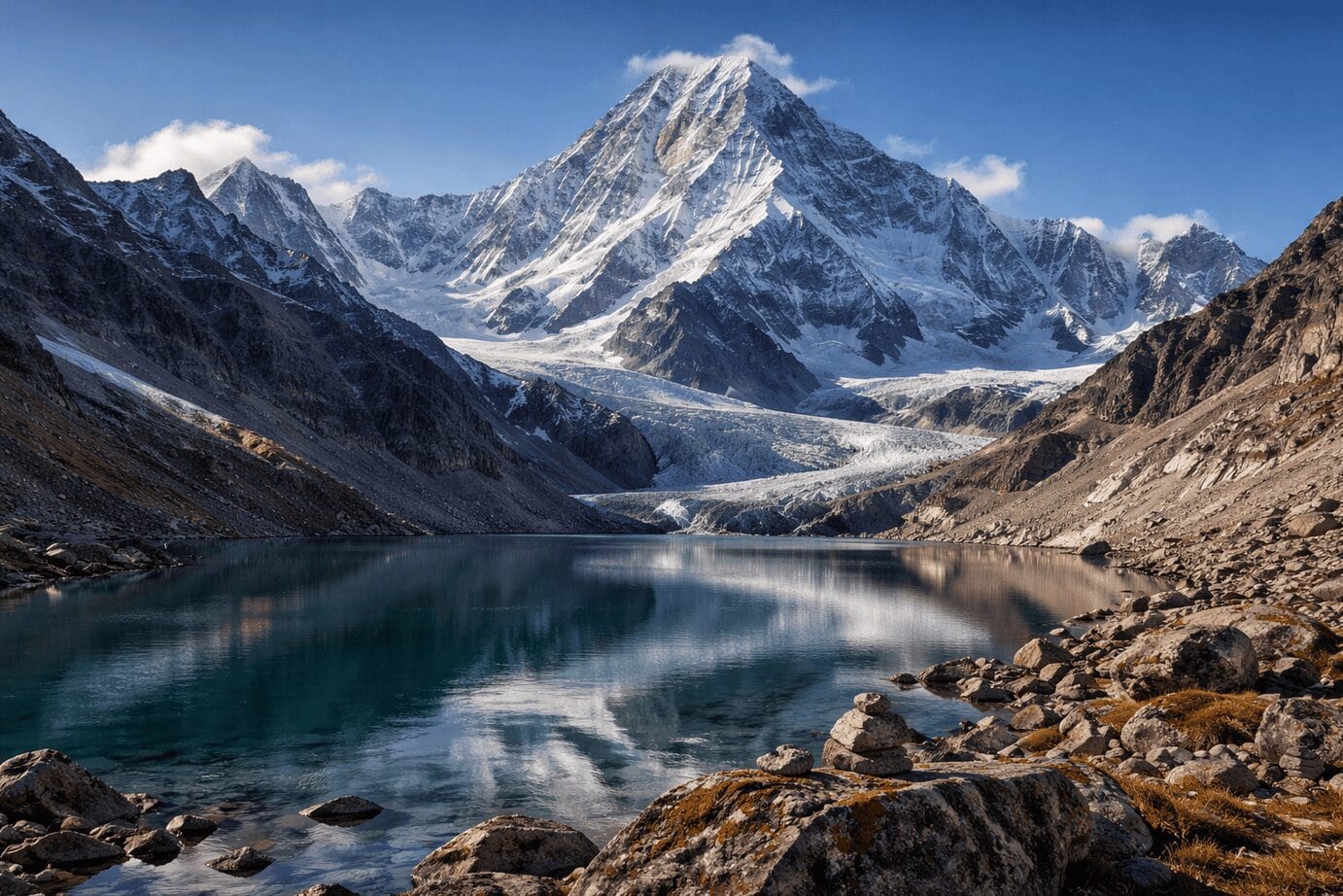
The towering pyramid of Mount Makalu Nepal rises with formidable grace along the border between Nepal and the Tibet Autonomous Region of China. At 8,485 meters (27,838 feet) above sea level, this magnificent peak claims its position as the fifth highest mountain in the world, commanding respect from mountaineers and nature enthusiasts alike. Its isolated location just 19 kilometers southeast of Mount Everest places it within one of the most spectacular mountain ranges on Earth, yet Mount Makalu Nepal maintains a distinct identity that sets it apart from its more famous neighbor.
The Geography and Location of Mount Makalu Nepal
Mount Makalu Nepal dominates the landscape where two nations meet, creating a natural boundary that has fascinated explorers for generations. The mountain sits within the Mahalangur Himalaya range, a subsection of the greater Himalayan mountain system. The peak straddles the border between the Sankhuwasabha District of Nepal’s Koshi Province and Tibet’s Tingri County, creating a shared treasure between two cultures.
The geography surrounding Mount Makalu Nepal presents one of the most pristine and untouched wilderness areas in the Himalayas. The Makalu Barun National Park encompasses the Nepali side of the mountain, protecting 1,500 square kilometers of diverse ecosystems. This protected area extends from subtropical forests at lower elevations to the stark, frozen landscapes near the summit. The park’s establishment in 1992 ensures that the natural beauty surrounding Mount Makalu Nepal remains preserved for future generations.
The mountain’s structure consists of a perfect four-sided pyramid with steep faces and knife-edge ridges. Each face presents unique challenges and distinct characteristics. The southeast ridge, which forms the border between Nepal and Tibet, serves as the standard climbing route. This ridge connects Mount Makalu Nepal to a subsidiary peak, Kangchungtse (Makalu II), which stands at 7,678 meters.
The Name and Cultural Significance
The name “Makalu” carries deep cultural resonance in the local communities. Derived from the Sanskrit words “Maha” meaning great and “Kala” meaning black, the name reflects the mountain’s imposing dark granite facades that appear almost black against the snow and sky. Local Sherpa and Tibetan communities have revered Mount Makalu Nepal for centuries, viewing it as a sacred entity deserving respect and spiritual consideration.
In Tibetan Buddhism, mountains hold profound spiritual significance, often considered dwelling places of deities and protectors. Mount Makalu Nepal features in local religious practices and oral traditions, though it receives less attention in written religious texts compared to some other Himalayan peaks. The indigenous populations who have lived in the shadow of this great mountain have developed a relationship with it that goes beyond mere physical presence, viewing Mount Makalu Nepal as a guardian and a source of both challenge and blessing.
Early Exploration and Climbing History
The history of human interaction with Mount Makalu Nepal follows the broader pattern of Himalayan exploration in the twentieth century. British expeditions surveying the region first documented the peak in the 1920s, though local populations had known of its existence for millennia. The mountain’s remote location and formidable appearance meant that serious climbing attempts came later than those on Everest and other major peaks.
The first reconnaissance of Mount Makalu Nepal for climbing purposes occurred in 1954 when an American expedition led by William Siri explored possible routes. However, the honor of the first ascent went to a French expedition the following year. On May 15, 1955, Jean Couzy and Lionel Terray reached the summit via the north face and northeast ridge route. The next day, Jean Franco, Guido Magnone, and Sirdar Gyaltsen Norbu also summited, followed by additional team members on May 17.
This French success story established Mount Makalu Nepal as one of the great prizes of mountaineering. The mountain had been climbed by only one expedition when it became the fifth eight-thousander to be summited by humans. The achievement demonstrated remarkable skill and determination, as the climbers faced extremely challenging conditions with equipment far less advanced than what modern mountaineers utilize.
The Challenge of Climbing Routes
Mount Makalu Nepal presents mountaineers with several route options, each demanding exceptional skill, endurance, and determination. The normal route, established by the French team in 1955, approaches from the Nepal side via the Arun Valley. Climbers typically establish base camp at approximately 5,000 meters, then work their way through a series of higher camps before attempting the final push to the summit.
The southeast ridge route requires climbers to navigate technically demanding sections, including the notorious knife-edge ridge that demands perfect balance and nerves of steel. The exposure on this ridge is extreme, with drops of thousands of meters on either side. Weather conditions can deteriorate rapidly, and the high altitude means that even the strongest climbers must contend with the physiological challenges of the death zone above 8,000 meters.
Alternative routes on Mount Makalu Nepal include the northwest ridge and various approaches from the Chinese side. The west face, attempted by several expeditions, presents even more significant technical challenges and has seen fewer successes. Each route demands careful planning, acclimatization, and respect for the mountain’s power. The steep pyramid shape means that there are no easy paths to the summit of Mount Makalu Nepal.
Winter ascents of the mountain represent the ultimate test of mountaineering prowess. The first winter ascent wasn’t achieved until 2009, when Simone Moro and Denis Urubko reached the summit on February 9. This accomplishment came 54 years after the first ascent, demonstrating the additional difficulties that winter conditions impose on this already challenging peak.
The Makalu Barun National Park
The Nepali side of Mount Makalu Nepal benefits from the protection afforded by the Makalu Barun National Park and its surrounding buffer zone. This conservation area encompasses some of the most biologically diverse terrain in the Himalayas, ranging from tropical forests at 435 meters elevation to the summit at 8,485 meters. This dramatic elevation gradient creates multiple ecological zones within a relatively compact area.
The park supports an impressive array of wildlife, including the endangered red panda, snow leopard, Himalayan black bear, and clouded leopard. Bird enthusiasts can observe over 400 species, making the region around Mount Makalu Nepal a paradise for ornithologists. The lower valleys contain rich forests of rhododendron, oak, and bamboo, while the higher elevations transition to alpine meadows and eventually bare rock and ice.
Conservation efforts in the park face multiple challenges, including balancing tourism development with environmental protection. The increasing number of trekkers and climbers visiting Mount Makalu Nepal creates both economic opportunities and environmental pressures. Park authorities work to implement sustainable tourism practices, including waste management programs and regulations on group sizes and camping locations.
The Barun Valley and Base Camp Trek
Trekking to the base camp of Mount Makalu Nepal offers adventurers an alternative to climbing the peak itself. The trek through the Barun Valley provides stunning views and an opportunity to experience one of the Himalayas’ most pristine wilderness areas. Unlike the crowded trails to Everest Base Camp, the route to Makalu Base Camp sees relatively few visitors, offering a more solitary and contemplative mountain experience.
The trek typically begins from the village of Tumlingtar, requiring approximately 18 to 20 days for the round trip. The trail passes through traditional Sherpa and Rai villages, crosses high mountain passes, and follows the Barun River through increasingly dramatic scenery. Trekkers gain intimate views of Mount Makalu Nepal from multiple angles, with the mountain’s distinctive pyramid shape dominating the skyline.
The base camp sits at approximately 5,000 meters in a spectacular amphitheater surrounded by towering peaks. Besides the main summit of Mount Makalu Nepal, trekkers can view several subsidiary peaks, glaciers, and the vast expanses of the surrounding Himalayas. The isolation and natural beauty of this location create a profound sense of being in one of Earth’s last wild places.
Climate and Weather Patterns
The climate around Mount Makalu Nepal follows typical Himalayan patterns, with distinct seasons that dramatically affect climbing conditions. The pre-monsoon period from April to May represents the primary climbing season, offering relatively stable weather and moderate temperatures. During this window, expeditions from around the world converge on the mountain, attempting to reach the summit before the summer monsoon brings heavy snowfall and dangerous conditions.
The monsoon season from June through September dumps massive amounts of snow on Mount Makalu Nepal, making climbing extremely dangerous. Avalanche risk increases dramatically, visibility decreases, and the combination of fresh snow and steep slopes creates deadly conditions. Very few expeditions attempt the mountain during these months.
Autumn, from October to November, provides a secondary climbing window. The weather typically stabilizes after the monsoon, though temperatures drop as winter approaches. Some climbers prefer the autumn season on Mount Makalu Nepal, citing clearer skies and more predictable conditions, despite the colder temperatures.
Winter conditions on the mountain are brutally harsh. Temperatures can plummet to minus 40 degrees Celsius or lower, winds can exceed 160 kilometers per hour, and the already thin air becomes even more oxygen-poor as atmospheric pressure drops. These factors explain why winter ascents of Mount Makalu Nepal remain rare achievements.
Ecological Importance and Biodiversity
The slopes of Mount Makalu Nepal support remarkably diverse ecosystems that change dramatically with elevation. The lower forests contain some of the richest biodiversity in the Himalayas, with countless plant species that include medicinal herbs used in traditional healing practices. The rhododendron forests, which bloom spectacularly in spring, create natural gardens of stunning beauty.
As elevation increases around Mount Makalu Nepal, the vegetation changes to alpine scrub, then to hardy grasses and lichens that can survive the harsh conditions. Even at extreme altitudes, life persists in forms adapted to cold, wind, and minimal nutrients. Scientists studying these ecosystems gain insights into adaptation and survival at the limits of what Earth’s conditions allow.
The glaciers surrounding Mount Makalu Nepal play crucial roles in regional water systems. Meltwater feeds the Arun River and its tributaries, providing water resources for communities downstream in Nepal and eventually contributing to the Ganges River system. Climate change threatens these glaciers, with potential consequences for water availability across vast areas of South Asia.
Modern Climbing Statistics and Challenges
Since the first ascent in 1955, Mount Makalu Nepal has seen hundreds of summit attempts with varying degrees of success. Statistics maintained by climbing organizations show that the mountain has a relatively low success rate compared to some other eight-thousanders. The technical difficulty, extreme weather, and remote location all contribute to the challenges climbers face.
The mountain’s fatality rate, while lower than some peaks like K2 or Annapurna, remains significant. Many fatalities occur during descent when climbers are exhausted and the dangers of altitude, weather, and technical terrain combine. Avalanches, falls, altitude sickness, and exposure all contribute to the toll that Mount Makalu Nepal extracts from those who challenge it.
Commercial guiding services now offer expeditions to Mount Makalu Nepal, though the mountain attracts fewer commercial clients than Everest or other more accessible peaks. The technical demands mean that clients must possess genuine climbing skills and experience. The expedition cost typically ranges from 30,000 to 60,000 US dollars, depending on the services provided and group size.
The Future of Mount Makalu Nepal
Looking forward, Mount Makalu Nepal faces challenges common to Himalayan peaks in the 21st century. Climate change continues to affect the mountain’s glaciers, potentially altering climbing routes and conditions. The increasing commercialization of Himalayan mountaineering raises questions about environmental impact and the preservation of wilderness values.
Conservation efforts must balance multiple interests, including the needs of local communities, the desires of climbers and trekkers, and the imperative to protect unique ecosystems. The relative isolation that has preserved the area around Mount Makalu Nepal may not last indefinitely as transportation infrastructure develops and tourism increases.
International cooperation between Nepal and China will remain essential for managing this border peak effectively. Both nations have interests in promoting tourism while protecting the natural environment. Joint management approaches could provide models for other transboundary conservation efforts in the Himalayas and beyond.
Conclusion
Mount Makalu Nepal stands as one of Earth’s greatest natural monuments, a testament to the geological forces that continue to shape our planet. Its perfect pyramid form, rising to 8,485 meters, captures the imagination of mountaineers and nature lovers worldwide. Whether approached as a climbing objective or admired from the trekking trails below, this magnificent peak offers experiences that few other places on Earth can match.
The mountain’s significance extends beyond its physical dimensions. Mount Makalu Nepal represents the enduring challenge of high-altitude mountaineering, the importance of wilderness conservation, and the cultural richness of the Himalayan region. As the fifth highest peak in the world, it occupies a special place in mountaineering history while maintaining an identity distinct from its more famous neighbors.
For those who venture into its realm, whether to climb its slopes or trek through its valleys, Mount Makalu Nepal provides transformative experiences. The mountain demands respect, preparation, and humility from all who approach it. In return, it offers views of unparalleled beauty, tests of personal limits, and a connection to one of the wildest places remaining on our planet. As we look to the future, ensuring that this remarkable mountain and its surrounding ecosystems remain protected becomes an obligation we share with coming generations.
More from The Daily Mesh:
- How Social Media Algorithms Shape the News We See: Understanding Algorithmic News Curation
- Brain Computer Interface: The Next Frontier in Human-Machine Communication
- Phone Ban in Schools: Balancing Discipline, Learning, and Digital Life