


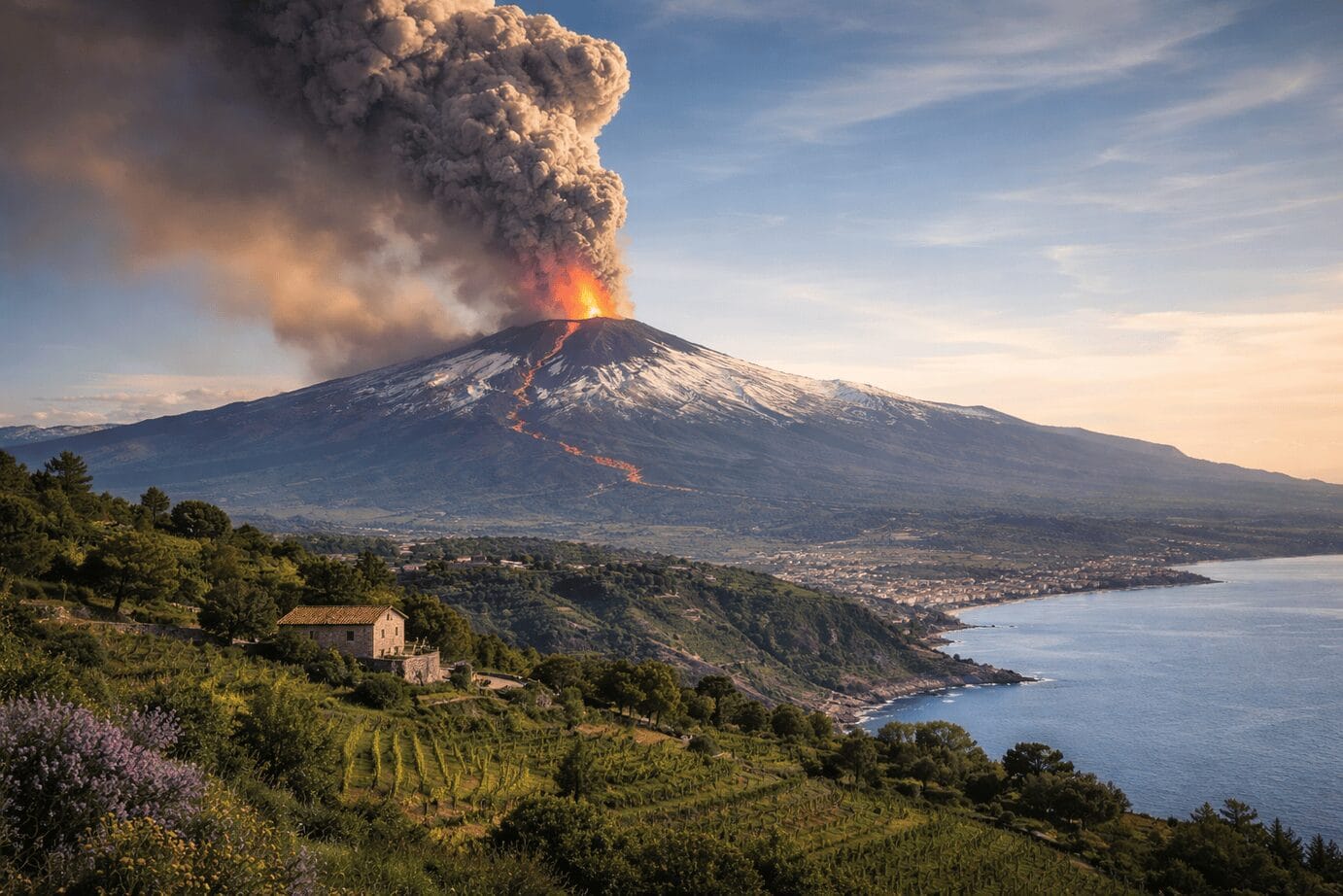
Standing at 3,357 meters above the Mediterranean Sea, Mount Etna Italy commands attention as one of the world’s most captivating natural wonders. This towering giant on Sicily’s eastern coast has been erupting for thousands of years, creating a landscape so otherworldly that ancient Greeks believed it was the forge of Hephaestus, god of fire and metalworking. Today, Mount Etna Italy attracts over a million visitors annually who come to witness the raw power of nature while exploring its fertile slopes, ancient craters, and moonlike terrain.
The volcano’s persistent activity makes it both a scientific marvel and a tourist destination unlike any other. While most people associate volcanoes with destruction, Mount Etna Italy represents something more nuanced—a force that simultaneously threatens and nourishes the communities living in its shadow. The volcanic soil supports thriving vineyards, orchards, and forests, while periodic eruptions remind residents of the mountain’s unpredictable temperament.
The Geological Powerhouse of the Mediterranean
Mount Etna Italy sits atop a complex tectonic intersection where the African plate slides beneath the Eurasian plate. This geological setting has created Europe’s tallest volcano and one of the most active on Earth. Unlike the catastrophic eruptions that destroyed Pompeii, Etna’s eruptions typically occur as effusive lava flows rather than explosive blasts, though the volcano certainly has its violent moments.
The mountain’s multiple summit craters constantly reshape its peak. The Southeast Crater, Northeast Crater, Bocca Nuova, and Voragine each contribute to the volcano’s dynamic nature. During particularly active periods, Mount Etna Italy can produce spectacular lava fountains that shoot hundreds of meters into the air, visible from towns dozens of kilometers away. These pyrotechnic displays illuminate the night sky with an orange glow that has inspired artists and poets for centuries.
Scientific monitoring stations dot the slopes, tracking seismic activity, gas emissions, and ground deformation. Researchers from the Italian National Institute of Geophysics and Volcanology maintain constant surveillance, providing early warnings when eruptions threaten nearby communities. This monitoring network makes Mount Etna Italy one of the most studied volcanoes globally, offering invaluable insights into volcanic processes.
A Chronicle of Fire: Etna Eruption History
The Etna eruption history stretches back approximately 500,000 years, though the current cone began forming around 100,000 years ago. Ancient historians documented eruptions, including Diodorus Siculus who recorded a massive event in 396 BCE that halted a Carthaginian army’s advance on Syracuse. Throughout antiquity, Greeks and Romans viewed the mountain with reverence and fear, incorporating it into their mythologies.
The medieval period witnessed devastating eruptions that destroyed villages and altered coastlines. In 1169, an earthquake associated with volcanic activity killed approximately 15,000 people in Catania. The 1669 eruption remains one of the most destructive in recorded Etna eruption history, producing lava flows that reached Catania’s walls and poured into the sea, creating new coastline. Citizens attempted to divert the flow by breaking through the solidified lava channel walls, marking one of humanity’s earliest volcanic intervention attempts.
Modern eruptions continue to shape the Sicilian volcanic landscape. The 1983 eruption threatened villages and prompted successful lava diversion efforts using explosives and earthen barriers. The 2002-2003 eruption produced spectacular activity from multiple vents, while seismic swarms damaged buildings in communities like Zafferana Etnea and Santa Venerina. More recently, frequent paroxysmal episodes have characterized the volcano’s behavior, with the Southeast Crater producing dramatic lava fountains and ash plumes.
Each eruption adds new layers to Mount Etna Italy, literally building the mountain higher. Volcanologists estimate the volcano grows approximately one meter per century through accumulated lava and tephra. This growth means elevation measurements constantly change, and topographic maps require regular updates.
Life in the Shadow of Fire
Approximately one million people live on or near Mount Etna Italy, creating one of the world’s most densely populated volcanic regions. Towns like Nicolosi, Zafferana Etnea, Linguaglossa, and Randazzo occupy strategic positions on the slopes, their economies deeply intertwined with the volcano. Rather than fleeing, Sicilians have learned to coexist with their unpredictable neighbor, developing a cultural relationship with the mountain that spans millennia.
The Sicilian volcanic landscape provides extraordinary agricultural opportunities. Volcanic soil, enriched by minerals from erupted material, supports some of Italy’s most distinctive agricultural products. Vineyards producing Etna DOC wines thrive on the slopes, creating elegant reds from Nerello Mascalese grapes and crisp whites from Carricante. These wines express the mountain’s terroir with mineral notes that enthusiasts attribute to the volcanic soil composition.
Citrus groves, olive trees, pistachios, and hazelnuts flourish in the fertile earth. The famous Bronte pistachios, grown on Etna’s western slopes, command premium prices for their intense flavor. Chestnuts from the mountain’s forests have sustained communities for generations, while mushrooms thrive in the volcanic soil’s unique chemistry. This agricultural bounty means local cuisine prominently features volcanic terroir, with restaurants celebrating Mount Etna Italy through regional dishes.
Architecture reflects volcanic realities. Traditional buildings incorporate lava stone, a durable construction material harvested from ancient flows. These distinctive black stones give towns their characteristic appearance while providing practical benefits—lava stone maintains stable temperatures and withstands seismic shaking better than conventional materials. Churches, palaces, and homes built centuries ago still stand, testament to volcanic rock’s durability.
Planning Your Visit: How to Visit Mount Etna
When you visit Mount Etna, choosing the right season significantly impacts your experience. Summer months offer clear skies and accessible trails, though crowds peak during July and August. Spring and fall provide pleasant temperatures with fewer tourists, while winter transforms the volcano into a ski destination, with snow covering the upper slopes from December through March.
Multiple access routes lead up Mount Etna Italy depending on your interests and physical abilities. The southern approach from Nicolosi via the Rifugio Sapienza offers cable car access to 2,500 meters, where specialized 4×4 vehicles can transport visitors higher toward the summit craters. The northern route from Linguaglossa through Piano Provenzana provides alternative access with different perspectives of the Sicilian volcanic landscape.
Guided tours range from gentle excursions suitable for families to challenging summit climbs requiring fitness and proper equipment. Licensed volcano guides lead expeditions, sharing geological knowledge while ensuring safety. Tours typically include visits to lateral craters, lava caves formed by flowing magma, and observation points offering panoramic views across Sicily to Calabria and Malta on clear days.
Independent hiking is possible on lower slopes, where marked trails wind through varying ecological zones. The easiest walks explore the Valle del Bove, a vast depression on Etna’s eastern flank carved by ancient collapses. More ambitious hikers tackle routes to secondary craters like the Monti Silvestri, formed during the 1892 eruption, or traverse lava fields where solidified flows create surreal landscapes.
When you visit Mount Etna, essential preparations include sturdy hiking boots, layered clothing for temperature changes, sunscreen, and plenty of water. Even in summer, summit temperatures can drop dramatically with strong winds at higher elevations. Bringing a flashlight helps if you plan to explore lava tubes—underground caverns formed when molten lava drained from solidified channels.
The Living Laboratory of Europe’s Tallest Volcano
Scientists regard Europe’s tallest volcano as an unparalleled natural laboratory. Its accessibility and frequent activity allow researchers to study volcanic processes in real-time, advancing understanding of how volcanoes work and improving eruption prediction capabilities. The mountain hosts research stations, monitoring equipment, and experimental projects that contribute to global volcanology.
The volcano’s behavior patterns intrigue researchers. Unlike many volcanoes that erupt infrequently with long dormant periods, Mount Etna Italy demonstrates near-constant activity. Small eruptions occur regularly, while major events happen every few years. This frequent activity provides abundant data while preventing the pressure buildup that causes catastrophic explosions at other volcanoes.
Gas emissions receive particular attention. Mount Etna Italy releases massive quantities of volcanic gases, primarily water vapor, carbon dioxide, and sulfur dioxide. Monitoring these emissions helps predict eruptions, as changing gas ratios often signal rising magma. The volcano’s gas output significantly contributes to atmospheric chemistry on regional scales, occasionally producing sulfur dioxide clouds detectable across the Mediterranean.
Seismic activity accompanies most eruptions. Sensitive instruments detect thousands of small earthquakes annually as magma moves underground. Most tremors are imperceptible to humans, but occasionally significant earthquakes occur, causing damage to communities. The 2018 earthquake, though only magnitude 4.9, struck a populated area on the volcano’s southeastern flank, damaging hundreds of buildings and injuring dozens of people.
Wine, Culture, and Volcanic Tourism
The emergence of volcanic tourism has transformed local economies around Mount Etna Italy. Visitors increasingly seek authentic experiences that connect them with the mountain’s cultural and natural heritage. Wine tourism flourishes as enthusiasts discover Etna’s distinctive vintages. Wineries offer tastings and tours, explaining how elevation, sun exposure, and volcanic soil influence grape characteristics.
Traditional villages preserve cultural heritage while adapting to tourism demands. Randazzo, repeatedly threatened but never destroyed by lava flows, showcases medieval architecture built from lava stone. The town’s churches display artistic treasures, while narrow streets reveal glimpses of traditional Sicilian life. Linguaglossa on the northern slopes serves as a gateway for hikers and skiers, with restaurants serving mountain cuisine featuring local ingredients.
Cultural events celebrate the mountain’s significance. Religious processions honor saints believed to protect communities from eruptions, with Sant’Agata of Catania particularly venerated after her intercession allegedly stopped the 1669 lava flow. Folk traditions preserve stories of the mountain’s moods and mysteries, passed through generations who learned to read Etna’s signs.
Adventure sports capitalize on the Sicilian volcanic landscape. Mountain biking trails descend through lava fields and forests, offering thrilling rides with volcanic scenery. Paragliders launch from various points, soaring above craters and valleys with views stretching across the Mediterranean. Winter sports enthusiasts ski slopes that look over the sea, a rare combination found few places globally.
Ecological Zones and Biodiversity
Mount Etna Italy hosts remarkable biodiversity distributed across distinct ecological zones. The lower slopes, called the cultivated zone, extend to approximately 1,000 meters elevation. Here, human agriculture dominates with vineyards, orchards, and olive groves interspersed with towns and villages.
The forest zone, from 1,000 to 2,100 meters, features diverse woodland ecosystems. Oak forests transition to beech and birch at higher elevations, while Corsican pine and larch populate specific areas. These forests shelter wildlife including foxes, wildcats, martens, and numerous bird species. Endemic plants adapted to volcanic conditions thrive, including the Etna violet and Etna ragwort, found nowhere else on Earth.
Above 2,100 meters lies the alpine zone, where vegetation struggles against harsh conditions. Specialized plants occupy sheltered spots between lava rocks, displaying remarkable adaptations to extreme temperatures, poor soil, and intense solar radiation. Cushion-forming species dominate, creating miniature ecosystems that support insects and small animals.
The summit zone, above 3,000 meters, appears lifeless yet harbors extremophile bacteria and lichens capable of colonizing fresh lava. These pioneering organisms begin soil formation processes, eventually enabling plant succession. Studies of these biological communities provide insights into how life colonizes hostile environments.
Conservation efforts protect this unique ecosystem. Parco dell’Etna, established in 1987, encompasses approximately 59,000 hectares divided into zones with varying protection levels. The park manages tourism, preserves natural habitats, and supports sustainable development in surrounding communities. UNESCO recognized Mount Etna Italy as a World Heritage Site in 2013, acknowledging its geological significance and cultural importance.
Practical Information for Travelers
When planning to visit Mount Etna, understanding logistics ensures smooth experiences. Catania serves as the primary gateway, with its international airport connecting Sicily to major European cities. From Catania, buses operated by AST provide direct service to Rifugio Sapienza on the southern slope and Piano Provenzana on the northern side. Journey times range from 90 minutes to two hours depending on traffic and stops.
Renting a car offers flexibility for exploring surrounding villages and multiple access points. Roads climbing the mountain are generally well-maintained, though winter conditions may require chains. Parking areas at main tourist facilities accommodate vehicles, with fees typically modest.
Accommodations range from basic refuges near the summit to luxury hotels in surrounding towns. Mountain refuges provide simple lodging for early-morning summit attempts, while towns like Nicolosi, Zafferana Etnea, and Linguaglossa offer hotels, bed-and-breakfasts, and vacation rentals catering to various budgets. Many properties feature views of Europe’s tallest volcano, particularly spectacular during eruptions.
Budget considerations depend on chosen activities. Cable car and 4×4 transport to high elevations costs approximately 60-70 euros per person. Guided summit climbs range from 100-150 euros depending on group size and duration. Independent hiking costs nothing beyond transportation, while wine tours and cultural experiences vary widely in price.
Safety remains paramount when visiting an active volcano. Authorities close areas when eruptions threaten, and visitors must respect closures. Even during quiet periods, volcanic gases in certain areas pose risks, and changing weather conditions at high elevations can catch unprepared hikers off-guard. Travel insurance covering volcanic activity provides peace of mind, as eruptions occasionally disrupt travel plans.
The Future of Mount Etna Italy
Predicting Mount Etna Italy’s future challenges even experienced volcanologists. The volcano will certainly continue erupting, maintaining its status as Europe’s most active volcano for the foreseeable future. Understanding probable eruption scenarios helps communities prepare and visitors appreciate the dynamic environment.
Effusive eruptions producing lava flows will likely remain most common. These events, while destructive to property, rarely threaten lives due to lava’s relatively slow movement. Monitoring systems provide sufficient warning for evacuations, and intervention strategies developed over decades improve authorities’ ability to protect infrastructure.
Explosive eruptions remain possible, though less frequent. Ash emissions disrupt air travel, as demonstrated by various eruptions that closed Catania airport. These closures cause economic impacts and travel frustrations but protect aircraft from volcanic ash damage. Improved monitoring and coordination with aviation authorities minimize disruptions while maintaining safety.
Long-term concerns include potential sector collapses that could trigger tsunamis in the Mediterranean. Geological evidence shows such events occurred in the distant past, and ongoing monitoring tracks ground deformation that might signal instability. While risk remains low during any given year, understanding these possibilities ensures appropriate emergency planning.
Climate change may affect volcanic activity patterns, though relationships remain unclear. Melting ice caps on the summit could alter stress on the underlying magma system, potentially influencing eruption frequency or style. Researchers study these potential interactions to improve long-term hazard assessments.
Why Mount Etna Italy Captivates Humanity
The enduring fascination with Mount Etna Italy transcends scientific interest or tourist attraction. This volcano embodies nature’s power to create and destroy, nurturing civilizations while occasionally reminding them of their vulnerability. The mountain’s persistent activity means each generation experiences eruptions, maintaining cultural connections to volcanic phenomena.
Photographers chase the perfect shot of lava fountains illuminating night skies, while artists find inspiration in the stark beauty of the Sicilian volcanic landscape. Writers have immortalized Etna in literature from ancient times through contemporary works, each generation adding their interpretations to a rich cultural legacy.
For locals, the relationship with Mount Etna Italy defines identity. Despite periodic disruptions, residents cannot imagine life elsewhere. The mountain provides economic opportunities through agriculture and tourism while demanding respect and vigilance. This coexistence represents humanity’s ability to adapt and thrive in challenging environments.
Visitors find profound experiences connecting with geological forces shaping our planet. Standing on recent lava flows, still warm beneath the surface, or gazing into active craters where magma glows red against the darkness, creates visceral understanding of Earth’s dynamic nature. These encounters often prove transformative, shifting perspectives on humanity’s place within natural systems.
The volcano teaches humility. Despite technological advances and scientific understanding, humans remain spectators to Mount Etna Italy’s power. We can monitor, predict to some degree, and adapt, but ultimately the mountain operates according to geological imperatives indifferent to human concerns. This reality, rather than diminishing its appeal, enhances appreciation for the privilege of witnessing such raw natural forces.
Mount Etna Italy stands as testament to our planet’s vitality, a reminder that beneath the thin crust we inhabit, immense energies drive continental drift, build mountains, and reshape landscapes. For anyone seeking to understand Earth’s power and beauty, visiting Europe’s tallest volcano offers unmatched opportunities to witness geology in action while exploring a cultural landscape shaped by millennia of human-volcano coexistence. Whether sampling wines grown in volcanic soil, hiking through otherworldly lava fields, or simply watching the mountain’s plume drift across Mediterranean skies, every encounter with Etna reveals something profound about the dynamic planet we call home.
More from The Daily Mesh:
- How 3D Printing Technology Is Disrupting Manufacturing Faster Than Anyone Expected
- Astrology, AI, and the New Age of Spirituality
- Cyclo[48]carbon Cyclocarbon: A New Molecular Form of Carbon with a 48-Atom Ring