


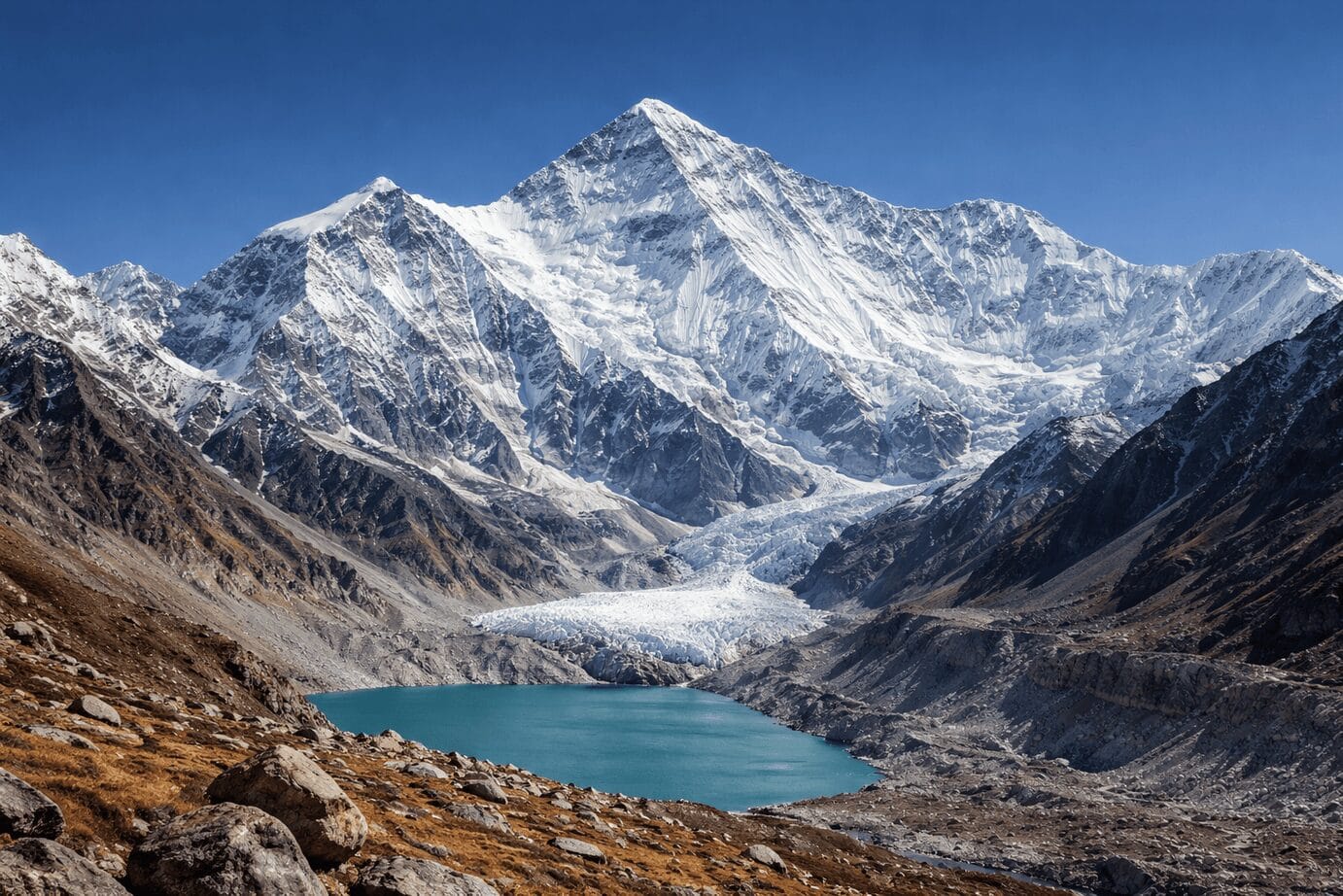
The massive pyramidal form of Mount Cho Oyu rises majestically along the border between Nepal and the Tibet Autonomous Region of China, commanding respect as the world’s sixth-highest mountain at 8,188 meters (26,864 feet). The name translates to “Turquoise Goddess” in Tibetan, a poetic reference to the mountain’s stunning appearance when bathed in certain light conditions. For mountaineers seeking to join the exclusive club of eighth-thousander summiteers, Mount Cho Oyu represents both an achievable goal and a formidable challenge.
Geographic Location and Geological Formation
Mount Cho Oyu occupies a prominent position in the Mahalangur Himalaya, approximately 20 kilometers west of Mount Everest. The peak sits directly on the international boundary, with its southern approaches lying in Nepal’s Solukhumbu District and its northern aspects in Tibet’s Tingri County. This strategic location places the mountain within one of Earth’s most concentrated zones of extreme elevation, surrounded by numerous other giants including Everest, Lhotse, and Makalu.
The geological history of Mount Cho Oyu mirrors that of the greater Himalayan range, formed through the ongoing collision between the Indian and Eurasian tectonic plates. This process, which began approximately 50 million years ago, continues today, causing the Himalayas to rise at a rate of several millimeters annually. The rock composition consists primarily of metamorphic and sedimentary layers, with evidence of ancient marine fossils found at high elevations—testament to the region’s dramatic uplift from a prehistoric ocean floor.
The mountain’s structure features three main ridges: the northwest ridge forming the standard climbing route from Tibet, the southwest ridge accessed from Nepal, and the southeast ridge connecting to the Nangpa La pass. These ridges converge at the summit, creating the distinctive pyramid shape visible from surrounding valleys and peaks.
Historical Expeditions and First Ascent
The climbing history of Mount Cho Oyu began in earnest during the 1950s, as mountaineers turned their attention to peaks beyond Everest and K2. A British reconnaissance expedition in 1951 first surveyed possible routes, though political restrictions in Tibet limited early attempts to the technically difficult Nepalese side.
The first successful ascent of Mount Cho Oyu occurred on October 19, 1954, when an Austrian expedition led by Herbert Tichy reached the summit via the northwest ridge from Tibet. Accompanying Tichy were Sepp Jöchler and Sherpa Pasang Dawa Lama. This achievement marked a significant milestone in Himalayan mountaineering, accomplished without supplemental oxygen—a remarkable feat for an eighth-thousander that demonstrated the mountain’s relative accessibility compared to other giants.
The expedition’s success owed much to meticulous planning, favorable weather conditions, and the team’s acclimatization strategy. Their approach established patterns that modern expeditions still follow, emphasizing gradual altitude gain and proper camp placement along the northwest ridge.
Following the first ascent, Mount Cho Oyu remained relatively quiet compared to Everest’s growing popularity. However, by the 1980s and 1990s, commercial expeditions began recognizing the peak’s potential as a training ground for aspiring eight-thousander climbers. Today, several hundred mountaineers attempt the summit annually, with success rates generally higher than those on Everest or K2.
The Northwest Ridge Route
The standard route on Mount Cho Oyu follows the northwest ridge from the Tibetan side, considered the technically easiest path to any 8,000-meter summit. This designation, however, remains relative—the climb demands excellent physical conditioning, proper acclimatization, and respect for the mountain’s objective hazards.
Access begins with a journey from Kathmandu or Lhasa to the Tibetan plateau, followed by a trek to base camp at approximately 5,700 meters. The approach crosses high desert terrain, offering spectacular views of the Himalayan range while allowing climbers to begin adapting to altitude. Base camp itself sits in a remote valley, with the mountain’s massive north face dominating the horizon.
From base camp, expeditions establish Advanced Base Camp (ABC) at roughly 5,900 meters, positioned at the foot of the northwest ridge. This camp serves as the primary staging area for summit attempts, with teams often spending several weeks here during the acclimatization phase. The location provides relative shelter from winds while maintaining proximity to the climbing route.
The route proceeds through three high camps. Camp 1, established around 6,400 meters, marks the transition onto steeper terrain. Camp 2 at approximately 7,100 meters sits in a more exposed position, where weather conditions become increasingly severe. Camp 3, the final camp before summit attempts, typically sits at 7,400-7,500 meters on a snow plateau.
The summit push from Camp 3 involves navigating moderately angled snow slopes interspersed with occasional ice sections. While technical climbing difficulty remains modest by eight-thousander standards, altitude effects become pronounced above 8,000 meters. The final pyramid requires sustained effort through thin air, with summit day often exceeding 12 hours round trip from Camp 3.
The Nepalese Southwest Ridge Alternative
Though less frequently attempted, the southwest ridge from Nepal offers an alternative route to Mount Cho Oyu’s summit. This approach presents greater technical challenges and sees significantly fewer expeditions, partly due to more complex logistics and steeper terrain.
The Nepalese route begins in the Khumbu region, following valleys that parallel those leading to Everest Base Camp before branching toward the Nangpa La, a high mountain pass historically used for trade between Tibet and Nepal. The approach trek traverses Sherpa villages and Buddhist monasteries, providing cultural immersion alongside physical preparation.
Base camp on the Nepalese side sits at approximately 5,400 meters, with the route ascending steep ridges and mixed rock and ice sections. The technical demands exceed those of the standard northwest ridge, requiring more advanced climbing skills and additional equipment. Weather patterns on this side also differ, with the southwest ridge experiencing different wind patterns and precipitation.
Despite increased difficulty, some mountaineers prefer the Nepalese approach for its scenic trekking, cultural experiences, and the satisfaction of completing a more challenging route. Success rates remain lower than the Tibetan side, with summit attempts dependent on stable weather windows and team capabilities.
Climate and Weather Patterns
Mount Cho Oyu experiences the typical Himalayan climate pattern, with distinct seasons dramatically affecting climbing conditions. Understanding these patterns proves essential for expedition planning and safety.
The pre-monsoon season from April to May offers the primary climbing window. During these months, temperatures moderate slightly, though still brutally cold at high elevations. Daytime temperatures at base camp may reach comfortable levels, while summit temperatures routinely drop below -30°C. Wind speeds vary, with the jet stream occasionally descending to mountain height, creating dangerous conditions.
The monsoon season from June through September brings heavy precipitation, unstable weather, and increased avalanche danger. Climbing during this period remains extremely hazardous and rarely attempted. Snow accumulation, poor visibility, and frequent storms make summit attempts ill-advised.
The post-monsoon season from late September through October provides a second climbing window, often considered superior to spring. Clearer skies, reduced precipitation, and more stable weather patterns characterize this period. However, temperatures drop significantly compared to spring, particularly at high camps.
Winter conditions from November through March create the harshest environment on Mount Cho Oyu. Extreme cold, high winds, and shortened daylight hours make winter ascents exceptionally dangerous. Only a handful of mountaineers have successfully summited during winter, and such attempts remain rare.
Acclimatization and Altitude Physiology
Success on Mount Cho Oyu depends critically on proper acclimatization—the physiological adaptation to reduced oxygen availability at high altitude. The human body undergoes numerous changes when exposed to the thin air above 5,000 meters, and rushing this process invites acute mountain sickness, pulmonary edema, or cerebral edema.
Most expeditions follow a gradual ascent profile, spending several weeks moving between camps at progressively higher elevations before attempting the summit. This “climb high, sleep low” strategy allows the body to stimulate red blood cell production, increase breathing rate, and make cellular-level adaptations that improve oxygen utilization.
At Mount Cho Oyu’s summit elevation of 8,188 meters, atmospheric pressure drops to approximately 35% of sea-level values. The partial pressure of oxygen decreases proportionally, meaning each breath delivers far less oxygen to the lungs than at lower elevations. Without proper acclimatization, even simple activities become exhausting, and cognitive function deteriorates rapidly.
Physical symptoms at extreme altitude include headaches, nausea, fatigue, and sleep disturbances. Mental effects range from impaired judgment to hallucinations in severe cases. Experienced climbers recognize these warning signs and adjust their pace or descend when necessary. The use of supplemental oxygen remains debated on Mount Cho Oyu, with many climbers attempting the summit without bottled oxygen, though others carry oxygen for emergency situations or to improve comfort and safety margins.
Environmental Concerns and Conservation
The increasing popularity of Himalayan mountaineering raises significant environmental concerns around Mount Cho Oyu and neighboring peaks. High-altitude regions prove particularly vulnerable to human impact due to extreme conditions that slow natural decomposition and restoration processes.
Expedition waste management has improved substantially in recent decades, with regulations requiring teams to remove all garbage, human waste, and equipment from the mountain. Base camps now typically employ systems for waste segregation and removal, though enforcement varies between the Tibetan and Nepalese sides. At high camps, the extreme environment makes comprehensive waste removal challenging, and abandoned equipment, oxygen bottles, and human waste accumulate over seasons.
Climate change manifests visibly on Mount Cho Oyu through glacial retreat, changing snow patterns, and altered weather predictability. Glaciers that historically provided stable routes now feature increased crevasse zones and ice instability. Seasonal weather windows show signs of shifting, with traditional patterns becoming less reliable for expedition planning.
The local Sherpa and Tibetan communities depend economically on mountaineering tourism while simultaneously bearing the environmental burden. Balancing economic development with environmental protection remains an ongoing challenge. Various organizations work toward sustainable mountaineering practices, including https://www.theuiaa.org promoting environmental responsibility among climbers and expedition operators.
Cultural Significance and Local Communities
Mount Cho Oyu holds deep spiritual significance for Tibetan Buddhists and local Sherpa communities. The peak, like many Himalayan giants, is considered sacred—a dwelling place for deities and an embodiment of natural power. This spiritual dimension adds layers of meaning beyond the purely physical challenge of climbing.
Sherpa culture has evolved alongside mountaineering development in the region. Sherpa guides and high-altitude workers possess not only exceptional physiological adaptation to altitude but also deep traditional knowledge of mountain conditions and routes. Their contributions prove essential to commercial expeditions, though recognition and compensation have historically been inadequate relative to their risks and expertise.
Tibetan communities on the northern side maintain traditional practices despite modernization and Chinese governance. Prayer flags marking sacred sites flutter in the harsh winds, and monasteries dot the approach routes. Mountaineers passing through these areas encounter a worldview where mountains represent more than mere physical challenges—they embody spiritual forces deserving respect and reverence.
The economic impact of mountaineering creates both opportunities and tensions within local communities. While expeditions provide employment and income, they also strain infrastructure, alter traditional lifestyles, and occasionally conflict with cultural values regarding appropriate mountain conduct. Respectful engagement with local communities and cultural practices enhances expedition experiences while supporting sustainable tourism development.
Preparation and Training Requirements
Aspiring Mount Cho Oyu climbers must undertake extensive preparation spanning physical conditioning, technical skill development, and logistical planning. Though considered the “easiest” eighth-thousander, the mountain demands serious commitment and capability.
Physical preparation should begin months or preferably years before an expedition. Cardiovascular endurance forms the foundation, with training programs emphasizing sustained aerobic activity at elevated heart rates. Many climbers incorporate running, cycling, swimming, and hiking with loaded packs to build the stamina required for long summit days at altitude.
Strength training complements endurance work, focusing on leg strength for uphill climbing and core stability for load carrying and balance on technical terrain. Upper body strength becomes relevant when using fixed ropes and managing climbing equipment.
Technical skill requirements for the standard northwest ridge remain modest, but climbers should possess competence in crampon use, ice axe technique, fixed rope ascension and rappelling, and basic glacier travel. Prior experience on smaller peaks helps develop movement efficiency and confidence in mountain environments.
High-altitude experience proves invaluable. Many mountaineers approach Mount Cho Oyu as a stepping stone toward Everest or other extreme peaks, and previous experience above 6,000 or 7,000 meters provides insight into personal altitude response and capabilities. Resources like the American Alpine Club at https://americanalpineclub.org offer educational programs and community connections for developing mountaineering skills.
Mental preparation receives less attention than physical training but proves equally important. Expeditions lasting six to eight weeks test patience, resilience, and ability to manage discomfort, boredom, and interpersonal dynamics in stressful conditions. Developing mental toughness and adaptive coping strategies enhances both safety and enjoyment.
Expedition Logistics and Costs
Mounting a Mount Cho Oyu expedition requires substantial financial resources and logistical coordination. Commercial expeditions typically charge between $20,000 and $45,000 per person, depending on service levels, group size, and operator reputation. These costs cover permits, base camp infrastructure, food, Sherpa support, and some equipment.
The Chinese climbing permit for Mount Cho Oyu costs several thousand dollars per person, with fees varying based on group size. Nepalese permits typically cost less but come with additional complexities regarding access and logistics. Permit processes require advance planning, as authorities process applications on specific schedules.
Travel to and from the mountain involves international flights to Kathmandu or Lhasa, ground transportation across challenging terrain, and the approach trek. These logistical elements add time and expense while providing acclimatization benefits and cultural experiences.
Equipment requirements span personal climbing gear, high-altitude clothing, sleeping systems rated for extreme cold, and technical hardware. Many expeditions provide group equipment like tents, ropes, and cooking systems, but personal gear remains each climber’s responsibility. Quality equipment proves essential for safety and comfort, with failures potentially catastrophic at extreme altitude.
Insurance represents another critical consideration. Standard travel and health insurance policies typically exclude high-altitude mountaineering. Specialized policies covering medical evacuation, rescue operations, and emergency treatment prove essential, as helicopter rescues from high camps can exceed $100,000 in costs.
The Future of Cho Oyu Mountaineering
The future of mountaineering on Mount Cho Oyu reflects broader trends affecting Himalayan climbing. Increasing accessibility through improved transportation and communication infrastructure brings more climbers to the region, raising questions about sustainability and mountain preservation.
Technological advances continue transforming the expedition experience. Satellite communication enables constant connectivity, weather forecasting provides increasingly accurate predictions, and equipment innovations improve safety and comfort. These developments potentially democratize extreme mountaineering while altering the fundamental nature of the endeavor.
Climate change presents the most significant challenge facing Mount Cho Oyu and all Himalayan peaks. Continued warming threatens glacial stability, alters traditional climbing routes, and potentially makes certain approaches too dangerous to attempt. Adaptation strategies and possibly route modifications will become necessary as conditions evolve.
Regulatory frameworks governing climbing access and environmental protection continue developing on both the Tibetan and Nepalese sides. Stricter waste management requirements, potential permit limitations, and increased fees may reshape the mountaineering landscape. Balancing access with preservation remains an ongoing negotiation among governments, commercial operators, independent climbers, and local communities.
Conclusion
Mount Cho Oyu stands as both an accessible introduction to eight-thousander climbing and a serious mountaineering objective demanding respect, preparation, and humility. Its position along the Nepal-China border, its stunning beauty justifying the “Turquoise Goddess” name, and its role in Himalayan climbing history make it far more than simply the sixth-highest mountain on Earth.
For those who stand on its summit after weeks of effort, acclimatization, and perseverance, Mount Cho Oyu offers rewards beyond the physical achievement. The experience encompasses cultural immersion in Sherpa and Tibetan communities, personal growth through challenge and adversity, and the privilege of witnessing Earth’s most spectacular high-altitude landscapes. As mountaineering evolves and challenges mount regarding sustainability and climate change, Mount Cho Oyu will continue serving as a proving ground for ambitious climbers while demanding thoughtful stewardship from all who venture onto its slopes.
More from The Daily Mesh:
- Typhoon Emong Wreaks Havoc: Floods and Typhoons Threaten 500,000 in Pampanga and Central Luzon
- AI in Political Campaigns – A Deep Dive into How AI Is Being Used in Political Campaigning
- Cinco de Mayo 2025: History, Significance, and Modern-Day Celebrations