


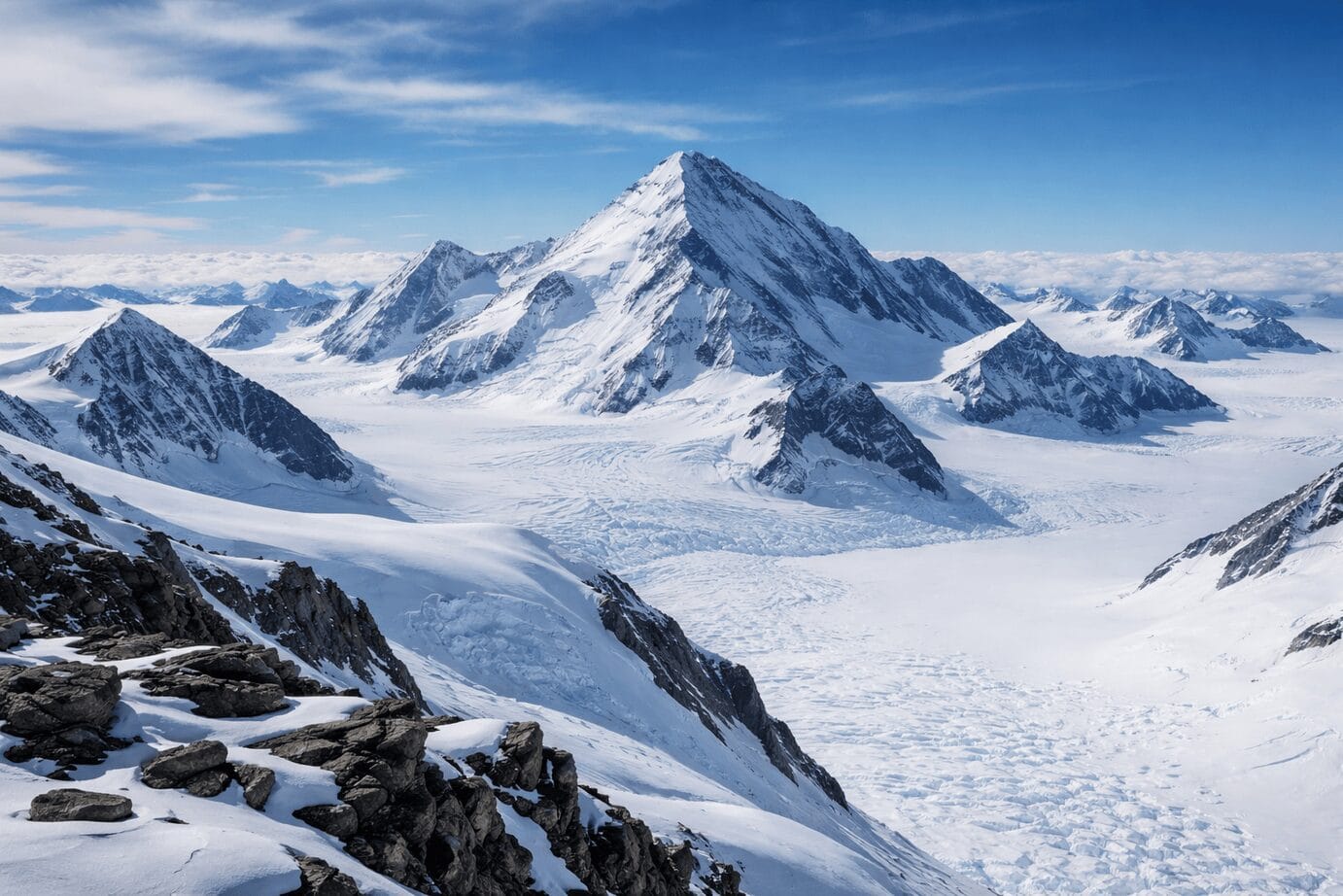
Standing at 4,892 meters (16,050 feet) above sea level, Mount Vinson Antarctica represents one of the most remote and challenging climbing destinations on Earth. Located deep within the frozen continent, this imposing peak attracts adventurers from around the globe who seek to test their limits against extreme cold, isolation, and the unforgiving Antarctic environment. As the highest point on the world’s coldest, driest, and windiest continent, Mount Vinson Antarctica offers mountaineers an experience unlike any other summit pursuit.
Discovery and Geographic Significance
The history of Mount Vinson Antarctica begins relatively recently in mountaineering terms. American pilot Lincoln Ellsworth first spotted the Sentinel Range from the air in 1935 during one of his pioneering Antarctic flights. However, the peak wasn’t officially identified and measured until 1957, when it was named after Carl Vinson, a U.S. Congressman from Georgia who championed Antarctic exploration and research funding.
The Vinson Massif, the mountain range containing Mount Vinson Antarctica, stretches approximately 21 kilometers long and 13 kilometers wide within the Ellsworth Mountains. This sentinel range rises dramatically from the Ronne Ice Shelf, creating one of Antarctica’s most spectacular geological features. The massif includes several other significant peaks, with Mount Vinson standing as the undisputed monarch of the range.
Geologically, the Ellsworth Mountains are composed primarily of sedimentary and metamorphic rocks dating back to the Cambrian period, making them some of the oldest exposed rock formations on the continent. The mountains’ formation relates to ancient tectonic processes that occurred before Antarctica separated from other landmasses in the supercontinent Gondwana. Scientists continue studying these formations to understand better the geological history of Antarctica and the forces that shaped our planet.
The Challenge of Antarctic Mountaineering
Climbing Mount Vinson Antarctica presents unique challenges that distinguish it from other major peaks worldwide. The extreme remoteness means climbers cannot simply walk away from difficulties—rescue operations in Antarctica are extraordinarily complex and expensive, sometimes impossible depending on weather conditions. This reality demands exceptional preparation, self-reliance, and conservative decision-making from every expedition member.
Temperature conditions on Mount Vinson Antarctica can plummet to minus 40 degrees Celsius or lower, with wind chill factors pushing perceived temperatures even further down the thermometer. These extreme cold conditions require specialized gear, including expedition-grade down suits, vapor barrier boots, and face protection systems that prevent frostbite while allowing adequate breathing and vision. Even with proper equipment, managing cold exposure requires constant vigilance and experience.
The logistics of reaching Mount Vinson Antarctica begin long before stepping onto Antarctic ice. Climbers typically fly from Punta Arenas, Chile, to Union Glacier, a blue-ice runway operated during the brief Antarctic summer season from November through January. From Union Glacier, smaller ski-equipped aircraft transport climbers to Vinson Base Camp, located at approximately 2,100 meters elevation on the Branscomb Glacier. This multi-leg journey can take days and depends entirely on weather windows in one of Earth’s most unpredictable climatic zones.
The Standard Route and Climbing Progression
The normal route up Mount Vinson Antarctica follows the western flank, a path established during the first ascent in 1966 by an American team led by Nicholas Clinch. This route doesn’t require technical rock climbing or extreme ice work, making it accessible to fit mountaineers with solid winter camping skills and high-altitude experience, though “accessible” remains relative when discussing Antarctic mountaineering.
From Base Camp, expeditions establish Camp One at approximately 2,700 meters, typically reached after a gradual approach across the Branscomb Glacier. The terrain here consists of relatively moderate snow slopes, but the elevation gain and cold exposure provide early tests of acclimatization and equipment systems. Climbers often spend several days moving between Base Camp and Camp One, ferrying supplies and allowing bodies to adjust to the altitude.
Camp Two sits at roughly 3,700 meters on a shoulder of the mountain, positioned below the steeper sections leading to the summit pyramid. The climb from Camp One to Camp Two involves sustained uphill travel with increased slope angles, demanding efficient crampon techniques and proper rope team protocols. Weather typically deteriorates at this elevation, with increased wind exposure requiring sturdy tent placements and vigilant camp management.
The summit push from Camp Two to the top of Mount Vinson Antarctica covers approximately 1,200 vertical meters, usually attempted in a single long day lasting 10 to 14 hours round trip. The route ascends a broad snow face before reaching a ridgeline that leads to the summit plateau. While technically straightforward, the sustained elevation gain at altitude, combined with Antarctic cold, makes this push physically demanding. Climbers must maintain safe ascent paces, monitor each other for altitude sickness symptoms, and be prepared to turn back if conditions deteriorate.
The Seven Summits Quest
Mount Vinson Antarctica occupies a prestigious position as one of the Seven Summits, the highest peaks on each of the seven continents. This collection of mountains has become one of mountaineering’s most sought-after accomplishments, attracting climbers who pursue the complete set as an ultimate test of skill, endurance, and dedication. The Seven Summits list varies slightly depending on whether one uses the Bass or Messner version regarding Australia/Oceania, but Mount Vinson appears on both lists as Antarctica’s undisputed high point.
For many mountaineers, the Seven Summits represent a journey through diverse mountain environments and climbing challenges. Mount Vinson Antarctica typically comes late in this progression, primarily due to its cost and logistical complexity. Climbers usually tackle more accessible peaks like Kilimanjaro, Elbrus, and Aconcagua before committing to Antarctic mountaineering. This progression allows skill development and helps climbers determine whether they genuinely want to pursue Antarctic objectives.
The inclusion of Mount Vinson Antarctica in the Seven Summits has sparked philosophical debates within the climbing community. Some argue that its technical difficulty doesn’t compare to other major peaks, with the primary challenges being environmental and logistical rather than climbing-specific. Others counter that the extreme cold, total remoteness, and expedition self-sufficiency requirements make it a legitimate test worthy of its place among the world’s premier summits. Regardless of perspective, successfully climbing Vinson Massif demonstrates significant mountaineering competence and adventurous spirit.
Environmental Considerations and Conservation
Antarctica operates under unique international governance through the Antarctic Treaty System, established in 1961. This framework designates Antarctica as a natural reserve devoted to peace and science, with strict environmental protocols governing all activities on the continent. Climbing operations on Mount Vinson Antarctica must comply with these regulations, which mandate waste management procedures, wildlife protection measures, and minimal environmental impact practices.
All climbing expeditions must carry out everything they bring in, including human waste. Specialized systems collect and contain waste at camps, which is then transported back to Union Glacier for proper disposal. This “leave no trace” approach extends beyond waste management to include campsite selection, fuel usage, and route marking. Fixed ropes and camps must be removed at the season’s end, ensuring the Vinson Massif remains pristine for future visitors.
Climate change impacts are increasingly visible in the Ellsworth Mountains region. While Mount Vinson Antarctica itself remains deeply frozen, surrounding ice shelves show signs of transformation. Scientists monitoring the area document changes in ice dynamics, temperature patterns, and weather systems that may affect future climbing conditions. These observations contribute to broader climate research while reminding climbers that even Antarctica’s most remote corners aren’t immune to global environmental changes.
The limited climbing season on Mount Vinson Antarctica actually benefits conservation efforts by concentrating human presence into a brief window and limiting overall visitation numbers. The high cost and logistical barriers naturally restrict traffic, preventing the overcrowding issues that plague more accessible peaks. Most seasons see fewer than 400 people attempt Vinson, compared to thousands who climb mountains like Everest or Denali annually.
Preparation and Training Requirements
Aspiring climbers of Mount Vinson Antarctica should undertake comprehensive preparation extending well beyond physical fitness. While excellent cardiovascular endurance and strength are essential, success depends equally on technical skills, cold weather experience, and mental resilience. Most guide services require previous high-altitude experience, typically including successful ascents of major peaks like Denali, Aconcagua, or significant Himalayan mountains.
Physical training programs should emphasize sustained aerobic capacity, allowing climbers to maintain moderate exertion for eight to twelve hours while carrying heavy packs. Strength training focused on legs, core, and upper body helps manage the demands of pulling sleds, carrying expedition loads, and maintaining balance on varied snow conditions. Training with loaded packs on inclined terrain provides specific conditioning that translates directly to Vinson Massif conditions.
Cold weather camping experience is non-negotiable for Mount Vinson Antarctica attempts. Climbers must competently perform all camp tasks while wearing bulky gloves and managing extreme temperatures. This includes tent setup in high winds, operating stoves safely in confined spaces, managing sleeping systems for warmth, and maintaining equipment in conditions where mistakes can have serious consequences. Many climbers gain this experience on winter ascents of peaks like Mount Rainier, Denali, or comparable objectives.
Equipment selection for Antarctic mountaineering requires careful consideration and often significant investment. Expedition-grade down suits, vapor barrier boots rated for extreme cold, and multi-layered clothing systems represent essential foundations. Navigation tools must function reliably in extreme cold, and communication devices need adequate battery life despite temperature impacts. Most expeditions provide detailed equipment lists, but climbers must ensure every item meets the specific demands of the Antarctic environment.
The Climbing Season and Weather Patterns
The climbing season for Mount Vinson Antarctica extends from late November through early January, coinciding with the Antarctic summer when temperatures are marginally more tolerable and 24-hour daylight provides maximum working time. Even during this optimal window, conditions remain harsh by any reasonable standard, with temperatures rarely rising above minus 20 degrees Celsius and winds capable of pinning teams in camps for days.
Weather on the Vinson Massif can change rapidly, with storms rolling in from the polar plateau with little warning. High-pressure systems can bring relatively calm conditions ideal for climbing, but these settled periods rarely last more than a few days. Expedition schedules must build in substantial buffer time for weather delays, as attempting to summit during marginal conditions invites disaster. Most expeditions plan for 14 to 21 days on the mountain, though weather may extend stays considerably.
The perpetual daylight during Antarctic summer creates unique challenges for maintaining normal sleep-wake cycles. While allowing flexible scheduling for summit attempts and camp moves, the constant light can disrupt circadian rhythms and make quality rest difficult. Experienced Antarctic mountaineers use eye masks, establish strict “night” routines, and maintain watch schedules that help regulate team rhythms despite environmental cues suggesting otherwise.
Wind represents perhaps the most significant weather factor on Mount Vinson Antarctica. Katabatic winds descending from the polar plateau can generate sustained velocities exceeding 50 kilometers per hour, with gusts much stronger. These winds create dangerous wind chill conditions, reduce visibility through blowing snow, and make travel treacherous. Teams must recognize when winds exceed safe climbing thresholds and have the discipline to remain in camp regardless of schedule pressures.
Historical Expeditions and Notable Ascents
The first ascent of Mount Vinson Antarctica occurred on December 18, 1966, when an American team including Barry Corbet, John Evans, Bill Long, and Pete Schoening reached the summit. This expedition, supported by the American Alpine Club and National Science Foundation, marked a significant achievement in polar mountaineering and opened Antarctica’s highest peak to future climbers. Their success demonstrated that with proper logistics and determination, even Antarctica’s most remote summits could be reached.
Since that pioneering ascent, climbing activity on the Vinson Massif has gradually increased, though it remains one of the least-climbed major peaks due to access challenges and cost. The mountain saw its first female ascent in 1988 when a Chilean expedition successfully reached the summit. In subsequent years, climbers from dozens of nations have stood atop Mount Vinson Antarctica, representing the mountain’s growing status as an international mountaineering objective.
Speed records and solo ascents have added new dimensions to Vinson climbing history. The mountain has seen remarkably fast ascents by elite climbers who, with perfect conditions and superior acclimatization, have completed the route from Base Camp to summit in under six hours. Solo climbers have successfully navigated the route alone, though such attempts require exceptional self-sufficiency and assume considerable risk given the remote location and limited rescue possibilities.
The mountain has also witnessed tragedy, reminding climbers that Antarctic mountaineering demands constant respect. While Mount Vinson Antarctica has a relatively good safety record compared to technically harder peaks, the extreme environment means any incident becomes magnified. Frostbite, altitude sickness, and navigation errors in whiteout conditions have caused serious problems for various expeditions, underscoring the importance of proper preparation and conservative decision-making.
The Future of Climbing on Antarctica’s Highest Peak
As climate patterns shift and technology advances, the future of mountaineering on Mount Vinson Antarctica faces interesting questions. Will warming temperatures and changing weather patterns alter climbing conditions and seasonality? How will advancing communication technology and rescue capabilities affect the risk profile and decision-making of expeditions? These questions lack simple answers but merit consideration by anyone invested in Antarctic mountaineering’s future.
The economics of Antarctic expeditions continue evolving, with competition among operators potentially making Vinson more accessible to middle-class climbers who previously couldn’t afford the journey. However, increased accessibility raises concerns about overcrowding and environmental impact, even though Vinson’s remoteness naturally limits how many people can reasonably access it. Balancing access with conservation remains an ongoing challenge for expedition operators and Antarctic treaty nations.
Technological improvements in equipment and logistics have made Antarctic mountaineering safer and more efficient. Modern communication systems allow daily weather forecasts and emergency coordination that early expeditions couldn’t imagine. Better insulation materials, more efficient stoves, and improved clothing systems help climbers manage the extreme cold more effectively. These advances don’t eliminate risk but do shift the risk profile and potentially enable attempts that would have been impossibly dangerous in previous eras.
Mount Vinson Antarctica will likely remain a premier mountaineering objective for dedicated climbers pursuing personal challenges and the Seven Summits quest. Its unique combination of extreme environment, relative technical accessibility, and profound isolation creates an experience that no other mountain can replicate. For those willing to invest the time, money, and effort required, standing atop Antarctica’s highest point provides one of mountaineering’s most memorable achievements.
Conclusion
Mount Vinson Antarctica stands as a monument to human ambition and our drive to explore Earth’s most extreme environments. This frozen sentinel challenges climbers not with technical rock faces or avalanche-prone slopes, but with cold, remoteness, and the psychological demands of functioning effectively in one of the planet’s harshest environments. Successfully climbing the Vinson Massif requires comprehensive preparation, significant financial investment, and the mental fortitude to persevere through discomfort and uncertainty.
For mountaineers, the journey to Antarctica’s highest peak represents far more than adding another summit to a list. It offers profound lessons about self-reliance, risk management, and the humbling experience of confronting nature at its most raw and powerful. The mountain demands respect, rewards preparation, and provides memories that endure long after climbers return to warmer latitudes. Whether pursued as part of the Seven Summits quest or as a standalone objective, Mount Vinson Antarctica delivers an adventure that few other mountains can match, set against the incomparable backdrop of the world’s last great wilderness.
References
https://www.swisseduc.ch/glaciers/antarctica/vinson/index-en.html
https://www.coolantarctica.com/Antarctica
https://www.nsf.gov/geo/opp/antarct/treaty.jsp
https://www.britannica.com/place/Vinson-Massif
More from The Daily Mesh:
- August 22 Earthquake in the Drake Passage: Unraveling the Depths of a Subantarctic Tremor
- Thailand Political Crisis Deepens: PM Paetongtarn Shinawatra Suspended by Constitutional Court Amid Legal Firestorm
- How AI Regulation is Evolving in Different Countries