


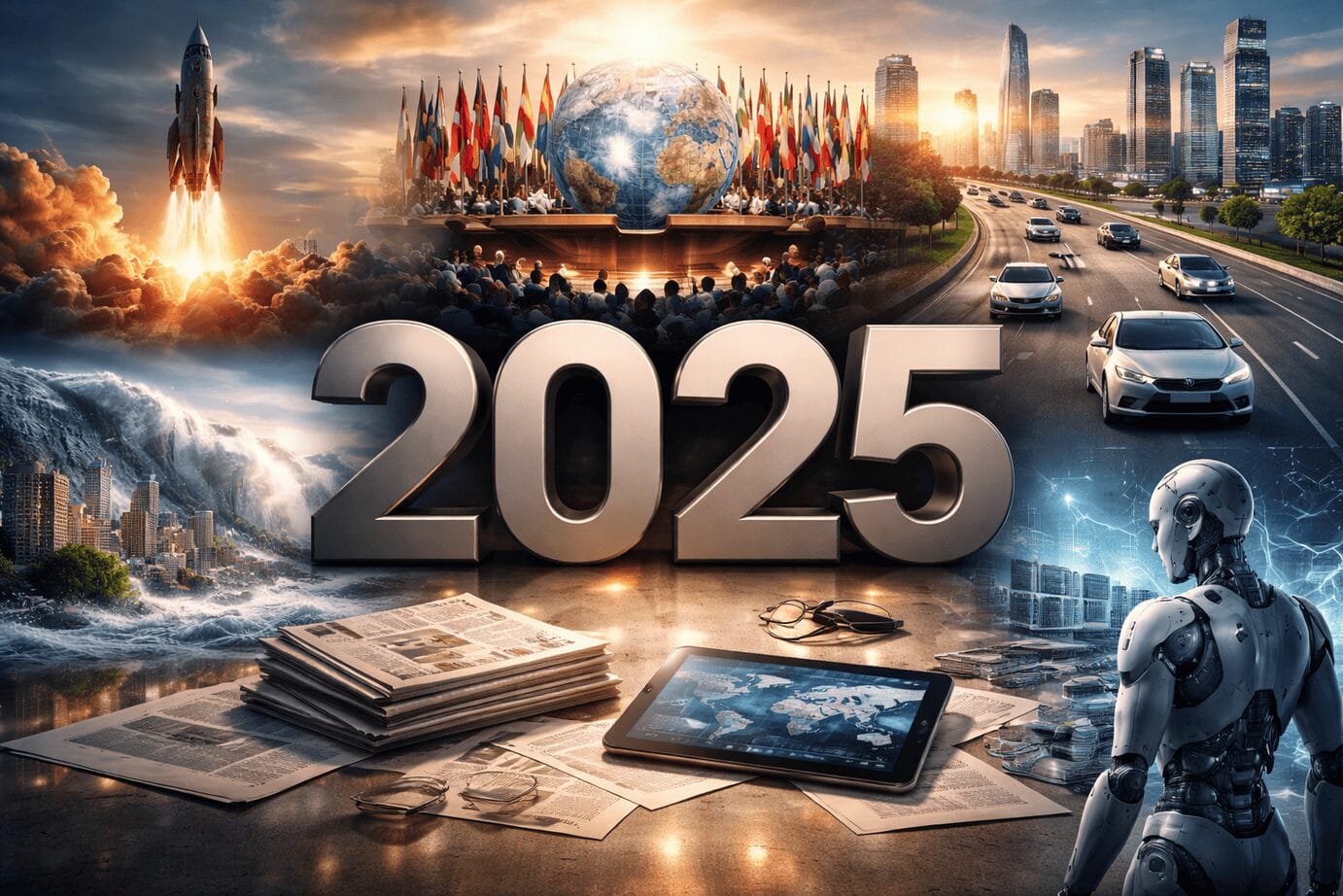
The year 2025 will be remembered as a defining chapter in human history, marked by catastrophic climate disasters, revolutionary technological breakthroughs, dramatic political shifts, and unexpected cultural moments that captivated billions. From the devastating Los Angeles wildfires that claimed hundreds of lives to artificial intelligence reaching unprecedented capabilities, the 2025 world events created a mosaic of challenges and triumphs that reshaped our collective future.
As we reflect on the twelve months that tested humanity’s resilience and ingenuity, one truth becomes abundantly clear: 2025 was not just another year on the calendar. It was a year that forced nations, communities, and individuals to confront existential threats while simultaneously celebrating remarkable achievements in science, diplomacy, and human connection.
Climate Catastrophes Define the Year’s Most Devastating Moments
The 2025 world events were dominated by an unprecedented series of climate disasters that shattered records and devastated communities across multiple continents. These environmental catastrophes served as stark reminders of the accelerating climate crisis facing our planet.
The Los Angeles Wildfire Tragedy
In January, Southern California experienced what would become the costliest wildfire disaster in United States history. The Palisades and Eaton fires erupted on January 7, fueled by severe drought conditions and hurricane-force Santa Ana winds. Over the course of 24 days, these infernos consumed more than 37,000 acres, destroyed over 16,000 structures, and tragically claimed approximately 482 lives through direct and indirect causes.
The economic impact exceeded $112 billion, surpassing even Hurricane Katrina’s inflation-adjusted toll. Communities like Altadena and Pacific Palisades were reduced to ash, while air quality remained at hazardous levels for weeks. The disaster marked a grim milestone among 2025 world events, highlighting how climate change is transforming wildfires from occasional disasters into routine catastrophes.
Texas Flash Floods: A Holiday Weekend Turned Deadly
The Fourth of July holiday in 2025 became synonymous with tragedy when Texas Hill Country experienced devastating flash flooding. In the early morning hours of July 3, a mesoscale convective vortex dumped over 20 inches of rain in under six hours. The Guadalupe River surged 26 feet in less than 90 minutes, creating a wall of water that engulfed campgrounds and communities.
Camp Mystic, a popular campsite, was among the hardest hit locations. The flash flooding killed more than 135 people, including 36 children who were spending their holiday weekend at various camps along the river. Climate scientists linked the intensity of these events to human-induced climate change, noting that warming temperatures increase atmospheric moisture, leading to more extreme rainfall events.
Southeast Asian Cyclones: A Region Overwhelmed
Late November brought catastrophic flooding to South and Southeast Asia when two tropical cyclones—Ditwah and Senyar—struck simultaneously. The storms battered Indonesia’s Sumatra island and Malaysia’s peninsula with torrential rain, triggering flash floods and devastating landslides.
The disaster killed more than 1,800 people and left approximately 1.2 million stranded without access to assistance. The economic damages exceeded $25 billion, making it the second most expensive climate disaster of 2025. Attribution research confirmed that climate change significantly intensified these storms, making such extreme weather events more frequent and severe in one of the world’s most climate-vulnerable regions.
Hurricane Melissa: Record-Breaking Atlantic Storm
In late October, Hurricane Melissa rapidly intensified to become one of the Atlantic’s strongest cyclones on record. The Category 5 storm made landfall on Jamaica’s southern coast on October 28, bringing extreme winds, torrential rainfall, and life-threatening storm surges. The following day, Melissa struck Cuba as a Category 3 hurricane, leaving a path of destruction across the Caribbean.
The storm tested the limits of adaptation in island nations already vulnerable to climate impacts. Scientists determined that climate change enhanced Melissa’s intensity, demonstrating how warming ocean temperatures are fueling more powerful hurricanes.
The Year’s Climate Toll
By year’s end, the top ten costliest climate disasters of 2025 had resulted in economic losses exceeding $120 billion globally. The first half of the year alone saw 14 billion-dollar weather disasters in the United States, contributing to over $101 billion in damages. These 2025 world events confirmed what climate scientists have long warned: the planet is experiencing the consequences of decades of greenhouse gas emissions, with 2025 tracking to become the second or third warmest year on record.
Artificial Intelligence Revolution Reshapes Technology Landscape
Among the most transformative 2025 world events was the rapid evolution of artificial intelligence, which reached new heights of capability while simultaneously facing a sobering reassessment of its limitations and potential.
OpenAI’s GPT-5 Launch: A New Era Begins
In August, OpenAI released GPT-5, marking what CEO Sam Altman called the beginning of a new era for humanity. The model, which became available to all ChatGPT users, represented a significant leap in intelligence, reasoning, and problem-solving capabilities. GPT-5 could switch between quick answers and deeper analysis depending on task complexity, demonstrating unprecedented versatility.
The release featured several groundbreaking improvements over previous models. GPT-5 achieved a 94.6% success rate on advanced mathematics problems, 74.9% on real-world coding challenges, and 84.2% on multimodal understanding tasks. The system was designed to be “generally intelligent,” though Altman cautioned it had not yet achieved artificial general intelligence (AGI) that thinks the way humans do.
By November, OpenAI followed with GPT-5.1, introducing Instant and Thinking modes to optimize responses based on user intent. In December, the company released GPT-5.2, specifically optimized for professional knowledge work including spreadsheet creation, presentation building, and complex coding tasks. These rapid iterations among 2025 world events highlighted the intense competition driving AI development.
The DeepSeek Disruption
One of the most significant AI-related 2025 world events occurred on January 20 when Chinese firm DeepSeek released its R1 model. The announcement sent shockwaves through the technology sector: DeepSeek R1 achieved performance comparable to leading Western models despite being trained for a fraction of the cost using less advanced chips.
The release wiped half a trillion dollars from chipmaker Nvidia’s market capitalization and prompted President Trump to call it a “wake-up call” for American AI dominance. Unlike Western counterparts, DeepSeek R1 was open-source, allowing anyone to download and use it freely. By year’s end, China had established itself as a strong second in the global AI race and the clear leader in open-source model development.
The Great AI Hype Correction
Despite remarkable advances, 2025 also witnessed what technology observers called “the great AI hype correction.” While AI companies had spent years presenting each release as exponential progress toward AGI, evidence mounted that large language models had inherent limitations.
Prominent AI researchers, including OpenAI cofounder Ilya Sutskever, acknowledged that LLMs excel at learning specific tasks but struggle to understand underlying principles. At the prestigious NeurIPS 2025 conference, only two of 5,000 papers mentioned AGI, signaling the academic community’s skepticism about imminent human-level artificial intelligence.
A MIT study in July became a focal point for discussions about AI’s economic viability, questioning whether the technology could deliver returns justifying the massive investments pouring into the sector. While AI continued advancing rapidly, 2025 marked a shift toward more realistic expectations about what these systems could—and could not—achieve.
AI Safety Concerns Emerge
The year also brought heightened scrutiny of AI safety following several high-profile incidents. Lawsuits emerged after cases where users developed unhealthy attachments to AI chatbots, prompting companies including OpenAI and Character.AI to implement new guardrails and safety measures.
OpenAI responded by measurably reducing problematic responses through systematic model updates. “We’ve been able to measurably reduce the prevalence of bad responses systematically with our model updates,” explained Nick Turley, head of ChatGPT, acknowledging that optimization had previously prioritized engagement over user wellbeing.
Trump’s Return Reshapes Middle East Dynamics
The 2025 world events in international affairs were dominated by President Donald Trump’s return to office and his unconventional approach to Middle Eastern diplomacy, which produced both breakthroughs and controversies.
The Gaza Peace Deal: Trump’s Diplomatic Triumph
After two years of devastating conflict between Israel and Hamas, Trump brokered what many considered his signature diplomatic achievement. On September 29, he announced the “Comprehensive Plan to End the Gaza Conflict” at a White House press conference alongside Israeli Prime Minister Benjamin Netanyahu. The agreement was signed on October 9 and came into effect the following day.
The 20-point peace plan, negotiated with extensive input from Arab and Muslim countries, aimed to end the war that had killed tens of thousands and displaced millions. By October 14, all remaining hostages had been released, Israeli forces had withdrawn to defensive positions, and humanitarian aid was flowing into Gaza. Trump visited Israel to address the Knesset, declaring the ceasefire marked “not only the end of war, but the end of an age of terror and death.”
International leaders praised the achievement, with Ukrainian President Volodymyr Zelenskyy calling it proof that “terror always loses when global unity is strong enough.” UK Prime Minister Keir Starmer called it Trump’s achievement, thanking him for “tireless efforts to deliver this moment.” The United Nations Security Council endorsed the agreement on November 17.
The Controversial Gaza Proposal
However, the path to peace was marked by significant controversy. In February, Trump had proposed that the United States take over the Gaza Strip and relocate its approximately two million Palestinian inhabitants, envisioning redevelopment of the territory into the “Riviera of the Middle East.”
The proposal drew swift international condemnation. Saudi Arabia rejected the plan outright, stating it would only establish diplomatic relations with Israel after an independent Palestinian state was created. Jordan’s King Abdullah II similarly refused to absorb Palestinian refugees. China condemned the proposal, and UN officials warned it would constitute ethnic cleansing.
Members of Trump’s own administration quickly walked back the permanent resettlement rhetoric, clarifying that any relocation would be temporary to allow for reconstruction. Trump himself sent mixed messages throughout February before ultimately abandoning the plan in favor of the more comprehensive peace agreement that emerged later in the year.
Strikes on Iran’s Nuclear Facilities
In June, Trump made one of his presidency’s most consequential decisions by ordering airstrikes on Iran’s Fordow nuclear facility. The strikes marked the first large-scale U.S. attacks on Iranian targets in nearly 40 years and represented a significant escalation in regional tensions.
The decision could either pave the way for renewed negotiations—potentially leading to a deal given Iran’s weakened position—or prompt Tehran to accelerate toward developing a crude nuclear device, which could trigger additional strikes by Israel and possibly the United States. By year’s end, the full ramifications of this decision remained unclear, though it significantly shaped the emerging Middle Eastern order.
Armenia-Azerbaijan Peace Declaration
Beyond the Middle East, Trump hosted additional diplomatic achievements. In August, he brought the leaders of Armenia and Azerbaijan to the White House for a U.S.-brokered peace declaration aimed at addressing decades of conflict over the Nagorno-Karabakh region. While fragile, the agreement demonstrated Trump’s willingness to engage in conflict resolution across multiple global hotspots.
Ukraine Conflict Enters Fourth Year With Mounting Casualties
Among the most sobering 2025 world events was the continuation and intensification of the Russia-Ukraine war, which entered its fourth year with no clear resolution in sight.
Russia intensified its missile and drone campaigns throughout 2025, repeatedly striking Ukrainian cities and causing heavy civilian casualties while damaging critical infrastructure. The year saw the highest civilian death toll since the war began in 2022. In March, Russia reclaimed its Kursk province, which Ukraine had seized in a surprise invasion in August 2024.
Russian forces made incremental territorial gains throughout the year, particularly around Pokrovsk, Hulyaipole, and in the Kharkiv and Zaporizhzhia regions. The grinding nature of the conflict, combined with mounting casualties and infrastructure damage, tested Ukrainian resilience and international support.
Unlike Trump’s successful Middle East diplomacy, efforts to broker peace in Ukraine remained elusive throughout 2025. The conflict continued to strain Western unity, impact global energy markets, and displace millions of Ukrainian civilians. As Ukrainian President Zelenskyy noted when praising the Gaza ceasefire, “If a ceasefire and peace have been achieved for the Middle East, the leadership and determination of global actors can certainly work for us too.”
Cultural Phenomenon: Swift and Kelce’s Engagement Captivates Millions
Not all 2025 world events involved geopolitics or catastrophe. Pop culture provided moments of joy and unity, particularly when Taylor Swift and Travis Kelce announced their engagement in August.
On August 26, the couple shared the news via concurrent Instagram posts featuring intimate photos from the proposal in a Missouri garden. “Your English teacher and your gym teacher are getting married,” they wrote, sending social media into a frenzy. The announcement broke Instagram records, accumulating over 30 million likes within 24 hours.
Kelce proposed using a cushion-cut diamond ring he had designed with Kindred Lubeck of Artifex Fine Jewelry in New York City. The proposal took place nearly two weeks before the announcement at a garden in Lee’s Summit, Missouri, following Swift’s surprise appearance on Kelce’s “New Heights” podcast where she announced her 12th studio album.
The engagement dominated headlines throughout the remainder of 2025 as the relationship continued blending pop culture and professional football in unprecedented ways. Swift had become a fixture at Kansas City Chiefs games since making their relationship public in September 2023. The Chiefs posted on Facebook that “today is a fairytale,” while Kansas City Mayor Quinton Lucas offered to officiate the wedding.
The cultural impact extended beyond celebrity gossip. Kansas City saw a 14% increase in flight searches for 2026, with travel analysts calling it a “fandom triple threat” combining the Chiefs’ continued dominance, the engagement announcement, and the city’s role as a 2026 FIFA World Cup host. Local establishments offered wedding venues, including Kansas City Public Library, which posted, “Taylor and Travis, we have the perfect wedding venue for you! Surrounded by love stories and parchment for your paper rings.”
Political Transitions Reshape Global Leadership
The 2025 world events included significant political transitions as multiple countries installed new national leaders, with some changes proving contentious and others historic.
Japan and Namibia Break Glass Ceilings
Two nations achieved important firsts in 2025. Japan inaugurated Sanae Takaichi as its first female head of government, marking a historic milestone for a country with traditionally male-dominated political leadership. Similarly, Namibia swore in Netumbo Nandi-Ndaitwah as its first woman leader, representing progress in African gender equality in governance.
African Political Instability
Several African nations experienced coups throughout 2025, contributing to regional instability. These upheavals highlighted ongoing challenges to democratic governance across the continent and raised concerns among international observers about the fragility of political institutions in affected nations.
Gen Z Protests Topple Nepali Government
Youth-led protests demonstrated the growing political power of Generation Z when demonstrations in Nepal resulted in the ouster of Prime Minister K.P. Sharma Oli. The movement reflected a broader trend of young people demanding accountability and change from established political structures, a pattern observed in various countries throughout 2025.
European Parliamentary Elections
Albania’s Socialist Party, led by Edi Rama, won reelection in May, retaining majority government control. Moldova’s incumbent pro-European party PAS secured reelection in September, forming another majority government. In the Czech Republic, ANO leader and former Prime Minister Andrej Babiš won a plurality of seats in October but failed to reach a majority, necessitating coalition negotiations.
Space Exploration Advances Despite Delays
While 2025 did not see humans return to the lunar surface, significant progress occurred in NASA’s Artemis program, positioning the agency for historic missions in coming years.
The Artemis program faced schedule adjustments throughout 2025 as engineers worked to resolve technical challenges. Artemis II, the first crewed mission to the Moon since 1972, was rescheduled for early 2026 after safety concerns required additional testing. The mission will carry NASA astronauts Reid Wiseman, Victor Glover, and Christina Koch, along with Canadian Space Agency astronaut Jeremy Hansen, on a 10-day journey around the Moon.
By October, NASA successfully integrated the Orion spacecraft with the Space Launch System rocket at Kennedy Space Center in Florida, completing critical communications testing between systems. The Artemis II crew conducted extensive training and simulations throughout 2025, preparing for various mission scenarios.
Artemis III, which aims to land the first woman and first person of color on the lunar surface, was rescheduled for mid-2027. The mission will send astronauts to the Moon’s South Pole, a region never before visited by humans, where they will spend nearly a week conducting scientific research.
In the commercial space sector, Firefly Aerospace achieved the first successful soft landing of a commercial lunar lander when its Blue Ghost touched down near Mare Crisium on the Moon, demonstrating the growing capabilities of private space companies.
Sports Milestones and Achievements
The 2025 world events included notable sports achievements that captivated fans globally.
Super Bowl LIX
The Kansas City Chiefs’ quest for a three-peat ended in heartbreak when they lost Super Bowl LIX to the Philadelphia Eagles on February 9. Despite the loss, the Chiefs remained dominant throughout the regular season, with Travis Kelce playing a central role in the team’s success. Taylor Swift attended the game, watching from the stands as her then-boyfriend competed on football’s biggest stage.
Inter Miami Wins MLS Cup
Lionel Messi led Inter Miami CF to the club’s first Major League Soccer Cup victory on December 6, cementing his impact on American soccer. The Argentine superstar’s influence extended beyond the field, driving unprecedented interest in MLS and contributing to the sport’s growing popularity in the United States.
First EF-5 Tornado in Over a Decade
While not a sporting event, extreme weather impacted sports communities when an EF-5 tornado struck Enderlin, North Dakota on June 20, marking the first tornado of that intensity worldwide in over twelve years. The twister generated peak winds exceeding 210 mph, tossing fully-loaded grain cars and hurling an empty tanker more than 475 feet.
Economic Impacts and Market Volatility
The 2025 world events had profound economic consequences that rippled through global markets and affected billions of people.
Climate Disaster Costs Soar
The economic toll of climate disasters reached unprecedented levels. The first half of 2025 alone generated over $101 billion in damages from weather-related events in the United States. Globally, the top ten costliest climate disasters resulted in $120 billion in economic losses, spanning wildfires, cyclones, extreme rainfall, flooding, and droughts across four continents.
These figures represented only insured losses and measurable economic damage. Losses difficult to quantify—including damage to livelihoods, lost income, long-term environmental harm, and permanent displacement—meant the true toll was substantially higher. Insurance companies faced mounting claims, leading to premium increases and coverage restrictions in high-risk areas.
AI Investment Continues Despite Correction
Despite the “hype correction” surrounding artificial intelligence capabilities, investment in the technology remained robust throughout 2025. Technology giants including OpenAI, Anthropic, Google, Meta, Microsoft, and Elon Musk’s xAI poured billions into AI development, computing infrastructure, and talent acquisition.
The competitive landscape intensified following DeepSeek’s January disruption, with Western companies declaring a “code red” to maintain their technological edge. OpenAI reached approximately 800 million weekly ChatGPT users by year’s end, demonstrating continued mainstream adoption despite questions about long-term economic returns.
Global Market Adjustments
The combination of ongoing geopolitical tensions, climate disasters, political transitions, and rapid technological change created market volatility throughout 2025. Supply chains remained stressed, inflation persisted in many economies, and central banks navigated the complex challenge of balancing growth against price stability.
Looking Forward: Lessons From 2025
As we reflect on the 2025 world events that shaped this turbulent year, several clear lessons emerge for the challenges ahead.
Climate change is no longer a distant threat but a present reality demanding immediate action. The $120 billion in disaster costs, hundreds of lives lost, and millions displaced demonstrate that adaptation and mitigation efforts must accelerate dramatically. Communities worldwide need enhanced infrastructure, improved early warning systems, and comprehensive resilience planning.
Artificial intelligence has proven to be a powerful tool with genuine capabilities and clear limitations. The technology will continue advancing, but the path to artificial general intelligence—if it exists—remains unclear. Responsible development, robust safety measures, and realistic expectations will be crucial as AI becomes increasingly integrated into daily life.
International diplomacy, even in an era of polarization, can still achieve breakthroughs. Trump’s Gaza peace deal demonstrated that sustained engagement, pressure on key actors, and coordination with regional partners can resolve seemingly intractable conflicts. However, the ongoing Ukraine war shows that some conflicts remain stubbornly resistant to diplomatic solutions.
The interconnection between climate, technology, politics, and culture means that 2025 world events cannot be understood in isolation. Taylor Swift’s engagement affects Kansas City tourism. AI developments influence geopolitical competition. Climate disasters strain government resources needed for other priorities. Understanding these connections will be essential for navigating future challenges.
Conclusion: A Year of Reckoning and Resilience
The 2025 world events presented humanity with perhaps its most challenging year in recent memory. From the devastating Los Angeles wildfires that claimed nearly 500 lives to the catastrophic flash flooding in Texas that killed over 130 people, from the breakthrough Gaza peace deal to the sobering reality check on artificial intelligence capabilities, 2025 forced difficult reckonings while celebrating remarkable resilience.
We witnessed the best and worst of human nature: the courage of first responders battling wildfires, the ingenuity of scientists advancing AI, the determination of diplomats forging peace, and the joy of millions celebrating a celebrity engagement. We also saw the devastating consequences of climate inaction, the fragility of democratic institutions, and the ongoing toll of protracted conflicts.
As we turn toward 2026, the 2025 world events leave us with both warnings and hope. The warnings are clear: climate change demands urgent action, technological advancement requires responsible stewardship, and international cooperation cannot be taken for granted. The hope lies in humanity’s demonstrated capacity to overcome challenges, achieve breakthroughs, and find unity even in divided times.
The question facing us now is whether we will learn from the 2025 world events and take the necessary steps to build a more resilient, sustainable, and peaceful world. The answer will define not just 2026, but the trajectory of this decisive decade in human history.
For more information on the events discussed in this article, visit:
- Council on Foreign Relations: https://www.cfr.org
- NASA Artemis Program: https://www.nasa.gov/humans-in-space/artemis
- Climate Central: https://www.climatecentral.org
- World Weather Attribution: https://www.worldweatherattribution.org
- OpenAI: https://openai.com
More from The Daily Mesh:
- Recognizing the Signs You Are Overtraining — How to Tell If You’re Overtraining
- How to Spot the Signs of Overthinking and Regain Mental Clarity
- Climate Refugees: The Next Global Humanitarian Crisis Unfolding